Sound Guide
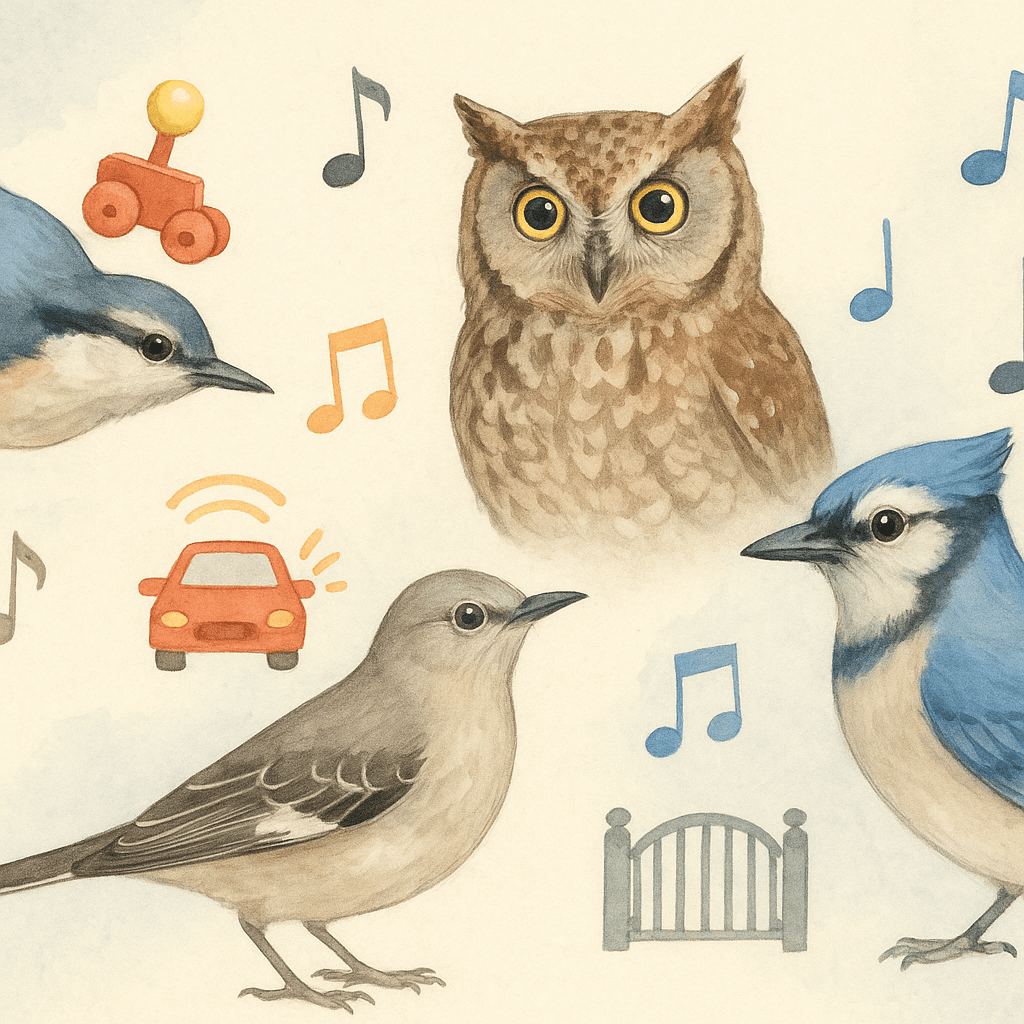
What Bird Sounds Like a Squeaky Toy?
If a bird sounds like a squeaky toy, car alarm, or rusty gate, meet 6 birds whose calls sound like everyday objects.
Read Article →
Learning to identify bird sounds is also one of the fastest ways to feel like birds are no longer random background noise but neighbors you actually recognize.
Whether you love doing things the "analog" way or you want to lean into apps like Wings & Whistles, this will give you a repeatable process to figure out who is singing.
If you want the speed run:
That is the high level loop. The rest of this guide is about doing it in a way that actually teaches your ear and fits into everyday life, not just one off "what was that" moments.
Throughout the guide, you can use any recording app for saving sounds, and apps like Wings & Whistles to make the process of noticing and identifying them more playful in the moment.
Most people try to identify bird sounds by memorizing names first. It works much better if you start by noticing shapes.
Think less "is this a robin" and more "what is this noise doing?"
Here are four things to pay attention to.
Ask yourself:
You do not need musical training. You can literally think in vibes:
Now listen to the timing.
You can tap the rhythm on your leg. If it feels like you could dance to it, that is useful information.
Many bird sounds are made of "phrases" repeated a few times.
Try to notice:
You might think "this bird does three quick notes, pause, three quick notes again."
This is where your brain is already weirdly good at birding.
People naturally describe bird sounds as:
Lean into that. "Squeaky shopping cart wheel at 2 am" is an excellent description.
After you hear a sound, say one sentence out loud to describe it.
Example: "High squeaky beeps, in sets of three, like a tiny car alarm."
Later, when you look at any notes or recordings, those sentences are worth gold.
Birds are not singing in a vacuum. They are singing in a very specific place, at a very specific time, for some reason.
You can often eliminate a lot of candidates just by paying attention to context.
Early morning
This is the classic dawn chorus window, where many species sing at once. Some birds are dawn specialists. If your mystery sound only shows up at first light, that matters.
Middle of the day
Often more contact calls and short phrases. Birds might be less dramatic but still vocal.
Night
If you hear songs or calls in the middle of the night, that is a completely different cast of characters. Owls, nightjars, mockingbirds, and a small crew of "night singers" come into play. Check out our guide to birds that sing at night for more.
Where are you physically standing?
Many common singers are strongly tied to particular habitats. A bird in dense shrubs is likely to be different from one shouting from the top of a tall pine.
If you can see the bird, even briefly, notice:
Behavior plus sound can narrow things significantly.
"High squeaky toy sound, repeating three notes, sung at night from the top of a streetlight in my city neighborhood" is a completely different puzzle from "low hooting sound from deep forest at dawn."
You do not need special equipment to capture useful bird audio. Your phone plus a bit of technique is enough.
Open your phone's built in voice recorder, or a bird sound app that listens through your microphone.
Hit record. A slightly messy recording is better than no recording.
And if the recording comes out messier than you hoped, with traffic, wind, or a second bird sitting on top of the one you wanted, you are not stuck with it. Our free Birdsong Isolator splits a recording into separate playable layers so you can hear one bird on its own.
Physically turn your phone toward the bird, or toward where you think it is. Try to:
Ten to twenty seconds of relatively clear audio is often enough for both your ears and most apps.
In the moment, jot down:
You can save this as text in the same memo or in your notes app so your audio and context live near each other.
Later, when you come back to this sound, you will not be thinking "what on earth is this file named 'Recording 73' again"
Before you feed the sound into an app, give your brain a chance to play.
You have three things to work with:
Ask yourself:
Even a rough guess like "probably small songbird, not an owl, not a goose" is useful.
Play your recording and really pay attention to:
That pure-versus-buzzy question trips up more people than any other, because a dry, buzzy trill is also the easiest bird sound to mistake for an insect. If you get stuck there, our guide to telling insect sounds from bird songs by ear walks through the exact cues.
Resist the urge to loop it a dozen times until your brain blurs it. Two or three focused listens, then move on.
This ear first moment matters because it is how your own skill grows. Apps are fantastic helpers, but you want your brain to eventually whisper "this sounds like a mockingbird" even before technology gets involved.
Now bring in the machines.
There are several categories of bird apps:
Wings & Whistles fits in that last category. It is built to make the act of noticing and identifying bird sounds feel like collecting characters in a game, rather than filling out a spreadsheet.
Here is a good way to combine different tools.
Run your recording through a sound ID app that can give you candidate species. Save or screenshot the list of suggestions if you want to refer back to it.
Treat the top suggestion as "strong candidate" rather than absolute truth. Think of it as "here are a few smart guesses."
For each suggested species:
If the suggested species lives on the wrong continent for your home, or the reference sounds are wildly different from your recording, set that option aside.
Once you are reasonably confident in an ID:
The next time you hear the same sound, you can check your list or play your old memo before even opening any external app. That is how the noise gradually turns into a familiar voice.
Even with great audio, apps will sometimes be wrong. Your own guesses will be wrong too.
That is not a failure. It is the training process.
When you discover you misidentified a sound:
"Not actually a hawk, it was a blue jay doing a hawk impression."
After a while, your notes become a scrapbook of "aha" moments instead of a list of errors.
To avoid making this feel like homework, treat bird sound ID as a series of little quests.
Here are a few you can try using any recorder and your favorite bird sound apps.
Pick a single common bird you hear often, like the one that sings closest to your bedroom window.
Once you recognize that voice anywhere, pick your next "main character."
Make a special place on your phone for sounds that remind you of non bird things:
Every time you record one, drop it into that folder or tag it in your notes. Over time, you will have a gallery of "what on earth was that" sounds that you can show friends, or just enjoy as the comic relief side of birding.
Check out our post on birds that sound like squeaky toys for people who want to go down that rabbit hole.
Next time you are awake early, record a familiar bird during the dawn chorus. Later that day, record the same species again.
Notice:
This is a great way to explore our dawn chorus article and night singers article in more depth, since they explore "when" birds sing.
You can absolutely lean on apps. That said, the most satisfying experience tends to be a combination:
Think of apps as calculators for your ears. They are powerful tools, but you still benefit from understanding what is going on.
You can usually start recognizing a handful of common species within a few weeks if you:
After a few months of casual practice, many people are surprised how "loud" the world suddenly feels, because there are familiar voices everywhere.
That usually means the recording is noisy or the sound is tricky.
You can:
If the app is confidently guessing three completely different species, treat all of them as "maybe" until you can collect better audio or get a visual.
Sometimes, yes. Many birds have very distinctive calls. Other times, one short sound is not enough.
If you only catch a single chirp:
Think of each recording as one puzzle piece. A single piece can be suggestive, but several pieces together are usually needed to see the full picture.
Identifying bird sounds is less about having a perfect ear and more about building a habit:
Whether you are logging every squeaky toy bird in your neighborhood or finally figuring out who sings outside your window at dawn, each new sound you name is another neighbor you will never unhear.
If you want a bit of playfulness layered on top of all this, Wings & Whistles is built to make the "what is that bird" moment feel like a little game instead of a quiz. The birds are already performing. You are just giving your brain a front row seat.
Start identifying mystery bird sounds Download Wings & Whistles Google Play
If a bird sounds like a squeaky toy, car alarm, or rusty gate, meet 6 birds whose calls sound like everyday objects.
Discover why birds like the American Robin and Northern Cardinal sing most vigorously at dawn.