
Learning Journey
Learn Bird Sounds with Wings & Whistles Learning Journeys
The in-app, gamified version of the seven-songs method. Short, paced, and on your phone.
Read Article →
Learning bird songs by ear sounds intimidating until you realize you already know a few. That titmouse whistling "peter peter peter." The chickadee at the feeder. You have been hearing them for years; nobody told you that counts. This is the gentle on-ramp: seven birds to learn first, a memory trick that works even if you cannot carry a tune, and a ten-minute-a-day rhythm that turns spring noise into named neighbors.
Quick honest note before we start: this list leans eastern, because that is where the bulk of US backyard listeners live. Western readers, swap Carolina Wren for Spotted Towhee or Bewick's Wren and the method still works exactly the same.
You do not need a good ear. You need a good filing system. Learning bird songs is not pitch-matching, it is pattern-matching. You are filing sounds in your head with names attached, and your brain is already extremely good at that. (You can pick out one friend's laugh in a crowded restaurant. Same skill. Different category.)
The first bird I learned by ear, I learned by accident. There was an Eastern Phoebe that hawked insects from the rail of my back porch every morning, calling out its own name in that raspy two-note "fee-bee, fee-bee" until I could not unhear it. By the end of April I could ID a phoebe by ear from three blocks away, and I had not done a single minute of focused study. That is the whole secret. Repetition does the work. You just have to give it something to repeat.
The reason most beginners stall is that they try to learn songs the way they learned vocabulary for a high school Spanish test: flashcards, isolated examples, panic. Songs do not stick that way. They stick the way song lyrics stick. Through context, through emotional anchor, through hearing them at the same time you are doing something else.
Here is the loop. Three steps. You will use it for every bird in this post and every bird after.
Step 1: Hear it. Play a clean ten-second recording, twice. Once with your eyes open looking at the bird's photo. Once with your eyes closed.
Step 2: Name it. Attach a mnemonic phrase. Words. "Birdy birdy birdy." "Cheerily, cheer up." "Tea-kettle, tea-kettle." The words do not have to be accurate. They have to be memorable. Your brain stores language better than tones, so we cheat by laundering the song through language on the way in.
Step 3: Hear it again, 24 hours later. This is the one most people skip, and it is the one that does ninety percent of the work. Spaced repetition (hearing the same sound a day after you first encoded it) turns a fragile memory into a durable one. This is also why cramming the night before never worked for that Spanish test.
That is the whole method. Six minutes per bird, spread across two days. You can do it on a lunch break. You can do it brushing your teeth. You can do it while the coffee brews. The goal is not to study harder. It is to put the sound in front of your ears more often, in lower-stakes contexts.
These seven were not picked because they are the prettiest or the rarest. They were picked because they are loud, common, and easy to remember. Three of them are probably singing within a hundred yards of you right now.
Start here. The Black-capped Chickadee literally says "chick-a-dee-dee-dee." It is the textbook backyard chickadee across most of the country, and across the southeast its near-twin the Carolina Chickadee picks up the same "chick-a-dee-dee-dee" on the same schedule. Either way, you already know one bird song. (Bonus fact: the number of "dees" on the end correlates with how worried the chickadee is about a predator. More dees, bigger threat. This is real science; Templeton et al. published it in Science.) Two songs really, since the chickadee also has a clear two-note whistle that sounds like "hey sweet-ie." Same bird. Different mood.

The Tufted Titmouse is the mnemonic dream. Once you hear it as the word "peter," you cannot un-hear it. Loud, clear, three repetitions, somewhere in the eastern half of the country, year-round. Pairs perfectly with the chickadee as your second song, because both birds work the same yards at the same hours and you can practice telling them apart in real time (chickadee buzzy and fuzzy, titmouse clear and whistled).

Another bird that says its own name, and the easiest two-syllable song on this list. The Eastern Phoebe calls "fee-bee, fee-bee" from a low perch (a railing, a wire, the back of a lawn chair) and then sallies out to grab a bug. The song is raspy, emphatic, and slightly buzzy on the second syllable, like someone clearing their throat into a kazoo. By early May, males are on territory across the eastern US and singing constantly. (Not to be confused with the chickadee's sweeter whistled "fee-bee" song from #1 — same syllables, very different timbre. The phoebe sounds like a smoker. The chickadee sounds like a flutist.) A quick geography note: western readers, you have Say's Phoebe instead; the Eastern Phoebe does not cross the Rockies.

Quick vocabulary detour. The American Goldfinch has a long warbly song too, but for beginners, learn the flight call first — it is the one you will hear most often and it is locked to that bouncy roller-coaster flight pattern. The flight call sounds like the bird is saying "po-ta-to-chip!" in four crisp syllables, usually delivered as the goldfinch dips through the air in undulating swoops. Once you know it, you will spot goldfinches by sound before you see them, every time. (Tiny seasonal aside: the males are molting into their bright yellow breeding plumage right now — some are already lemon-yellow, others still patchy with last fall's olive feathers. If you see a mottled olive-and-gold bird at your feeder, that is just a goldfinch caught mid-wardrobe-change.) We are skipping the warbly song on purpose; it sounds too much like House Finch, Purple Finch, and Pine Siskin to be a beginner's reference point. Flight call first, song later.

The cleanest mnemonic in birding, and the song you are most likely to catch right now as they pass through. Males are tuning up for the boreal forest, and a sunrise patch of brushy edge can give you the full "Oh sweet Canada Canada Canada" before they push north. The White-throated Sparrow is the gift of late April and early May for most of the lower 48. (Some old-timers hear the same song as "Old Sam Peabody, Peabody, Peabody." That is the regional alternate, and a good demonstration of the rule that mnemonics are personal.)

For a bird the size of your thumb, the Carolina Wren is shockingly loud. The "tea-kettle, tea-kettle, tea-kettle" phrase is loud enough to fill a whole yard, and once you know it, you will start hearing it in places you never noticed before. Parking lots, gas stations, ivy-covered walls. (Common in the southeast and mid-Atlantic, slowly pushing north. Western readers, this is your Spotted Towhee or Bewick's Wren slot.) It also demonstrates the "three-syllable repeating phrase" pattern that a lot of songbirds use, so once you have it, you will start filing other birds against it.

Here is a vocabulary upgrade most beginner posts skip. Jays do not really sing. They call. A song is a long, structured vocalization usually tied to breeding, territory, or mate attraction. A call is a shorter, more functional sound: an alarm, a contact note, a location ping. The Blue Jay is loud jeers, wheedly pumphandles, and dead-on Red-shouldered Hawk impressions. Including one bird that breaks the "pretty whistle" mold teaches you to listen for texture, not just tune, and gives you a vocabulary word (call vs. song) that pays off forever.

Why does "Oh sweet Canada" work and "a lovely flute-like song" not? Because your brain stores specific, weird, slightly-funny phrases better than abstract descriptions. The best mnemonics share three traits: they are short, they have matching rhythm, and they are weird enough to be sticky. "Tea-kettle" is three syllables and the song is three syllables. "Peter peter peter" matches the titmouse's clean, clear repetition; "potato chip" matches the four-syllable bounce of a goldfinch in flight. "A lovely flute-like song" is none of those things, which is why no one remembers it.
We wrote a whole guide to bird song mnemonics and the birds that sound like words, with the real audio next to each phrase so you can hear the words snap onto the song.
When the standard mnemonic does not click, invent your own. (Birders fight about this, and the fights are funny. There is a long-running debate about whether the White-throated Sparrow says "Oh sweet Canada" or "Old Sam Peabody." Both camps are correct, because both phrases work and the bird does not care.) The trick is to match the syllable count and rhythm of the actual song, even if your phrase is total nonsense. "Pizza pizza pizza" would work for a titmouse. So would "ladder ladder ladder." The song does not change. Your hook for it does.
Two weeks. Seven songs. Ten minutes a day. The rhythm:
Most of the ten minutes is passive. Open the window while you wash dishes. Keep a loop of two recordings playing while you make breakfast. Walk to the mailbox slowly. The active study (clicking play, looking at the photo, saying the mnemonic out loud) is maybe two minutes a day. The rest is just letting the sounds wash over you while you do other things, the way you absorb song lyrics without trying.
Day 14, you walk outside, hear a bird, and a name lands in your head before you have time to think about it. That is the moment. After that, every walk for the rest of your life is a little louder and a little more populated.
Three days in, you will hear a bird, freeze, and have absolutely no idea which one it is. This is normal. (It also happens to people who have been doing this for thirty years. The difference is that they have stopped being embarrassed about it.) The fix is not effort. The fix is exposure.
Forgetting a song you "learned" yesterday means the memory was fragile, not that you are bad at this. Re-listen, re-attach the mnemonic, and let twenty-four hours pass. The second time it sticks harder. The third time, it sticks for good. The cycle is the method, not a sign you are failing it.
The real test is not a quiz, it is a morning walk. Go outside. Walk slowly. Stop when you hear a bird. Try to name it before you check anything. Sometimes you will. Sometimes you won't. Either way, the walk itself is the practice. You are training your ears in their natural habitat, which is the only place this skill actually lives.
If you want this paced for you, the in-app version is what Wings & Whistles Learning Journeys are: short, audio-first lessons with the mnemonics built in. Same method, just on your phone.
Drill the 7 birds in this guide with short, audio-first lessons in W&W


Here is what nobody tells you until it happens: once seven songs are locked in, the next twenty come three times faster. Because now you have a comparison library. New bird? "Sounds like a chickadee but slower" or "reminds me of a titmouse but rougher." You can describe sounds in terms of sounds you already know, which is how every birder over forty actually thinks. The first seven are the steepest climb. After that, the trail levels off fast.
The next layer to add is migration. Spring brings warblers, thrushes, vireos. Voices that were not there in February and will not be there in August. If you want a roadmap for that jump, our guide to spring migration sounds walks the eight-week arc from March's opening notes to May's dawn chorus crescendo. After migration, you can dip into the broader how to identify bird sounds framework, and for the predawn front-porch experience, the dawn chorus guide picks up where this post leaves off.
The bigger reframe is this. Once you know seven songs, every bird you hear becomes either a regular (one of yours) or a rarity (something new to investigate). Most birds are regulars. That is the whole point. The reason this skill is worth learning is not that you become a walking field guide. It is that the world outside your window stops being anonymous. It becomes a place with named neighbors, and you become someone who can recognize them.
That is the gentle journey. Seven birds. Two weeks. Ten minutes a day. A door that opens once and never closes.
Most beginners can lock in seven common backyard songs in about two weeks at ten minutes a day. Real fluency, where you name a bird the second it opens its mouth, builds over months of casual exposure rather than focused study. The two-week win gets you started; the next year of walks does the rest.
Start with one bird you already kind of know, like the Black-capped Chickadee or Tufted Titmouse, and learn its song before adding a second. Then stack passive exposure on top of active study. Open the window while you do the dishes, leave a recording playing during your morning coffee, walk the same loop every day. Passive minutes count, and they are the difference between cramming and remembering.
Yes. People learned bird songs by ear for centuries using mnemonics, field notebooks, and patient walks with someone more experienced. An app speeds up the feedback loop and gives you confirmed audio for every species, but the underlying skill is pattern matching, not technology. The method works either way; the app just removes the guesswork.
Aim for about seven. That is not arbitrary. Cognitive research on category learning consistently lands in the five-to-nine range as the working-memory ceiling for new auditory categories before things start blurring together. Seven gives you a meaningful soundscape without overwhelming you, and once those seven are locked in, the next twenty come three times faster because you have a comparison library.
No. Adults actually have an advantage over kids for this kind of pattern recognition because we are better at attaching language and mnemonics to sounds we hear. The skill is not pitch perception, it is association, and association strengthens with practice at any age. Birders who started in their sixties routinely become the sharpest ears on the local walk within a few years.
In spring across the eastern and central US, listen first for Black-capped Chickadee, Tufted Titmouse, American Goldfinch (year-round across most of the country), and Carolina Wren as year-round residents, plus Eastern Phoebe wherever it is resident year-round (the southeast) or freshly back on territory (the rest of the east). Then add the spring arrivals you will not hear in July, especially White-throated Sparrow tuning up during migration and the dawn-chorus regulars returning from the south. The seasonal mix is part of why spring is the best time to start.
Start learning birds by ear. Every lesson is a little journey. Download Wings & Whistles Google Play
The in-app, gamified version of the seven-songs method. Short, paced, and on your phone.
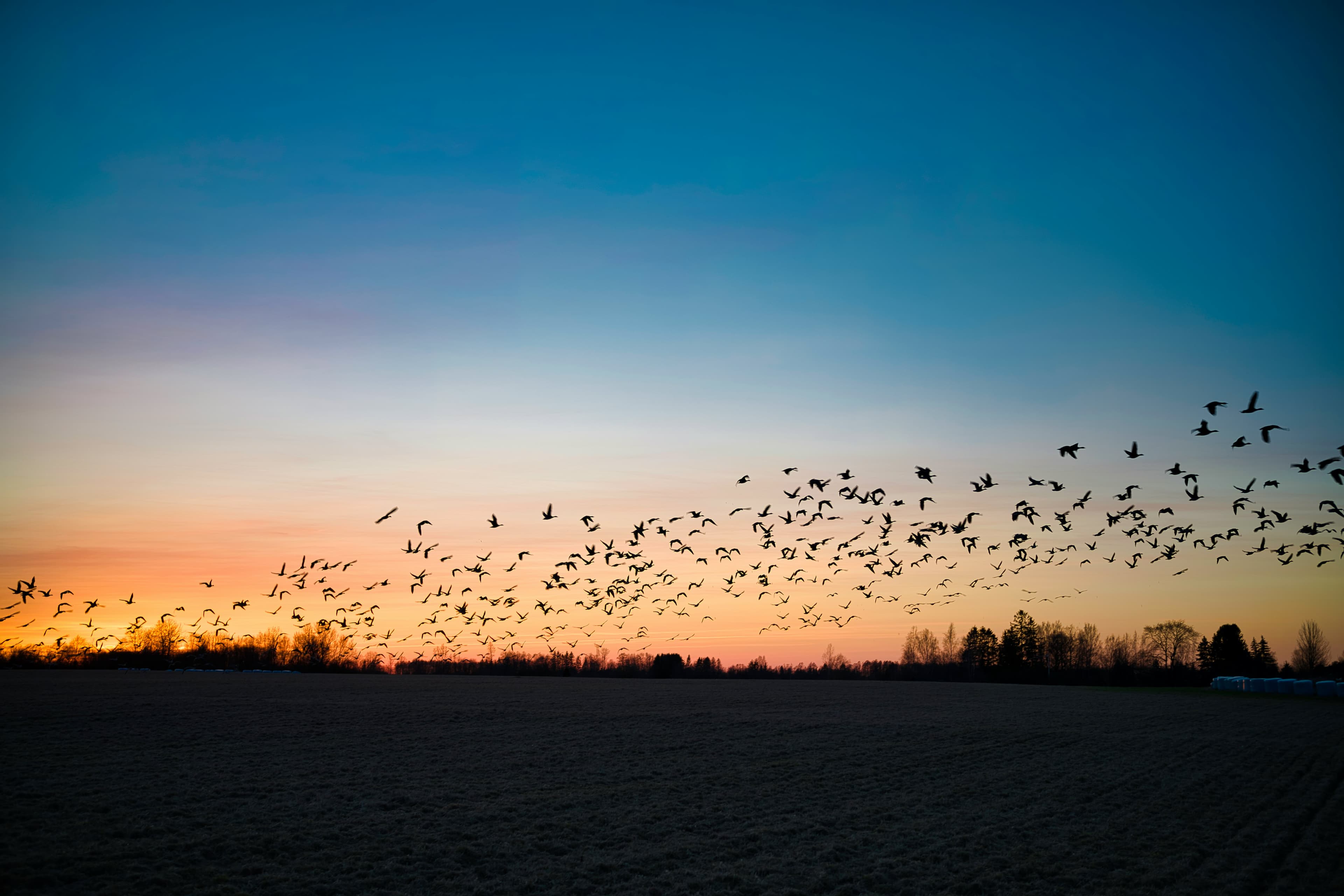
Once seven songs are locked in, migration brings the next layer. Warblers, thrushes, vireos. Voices that were not here in February.