Sound Guide
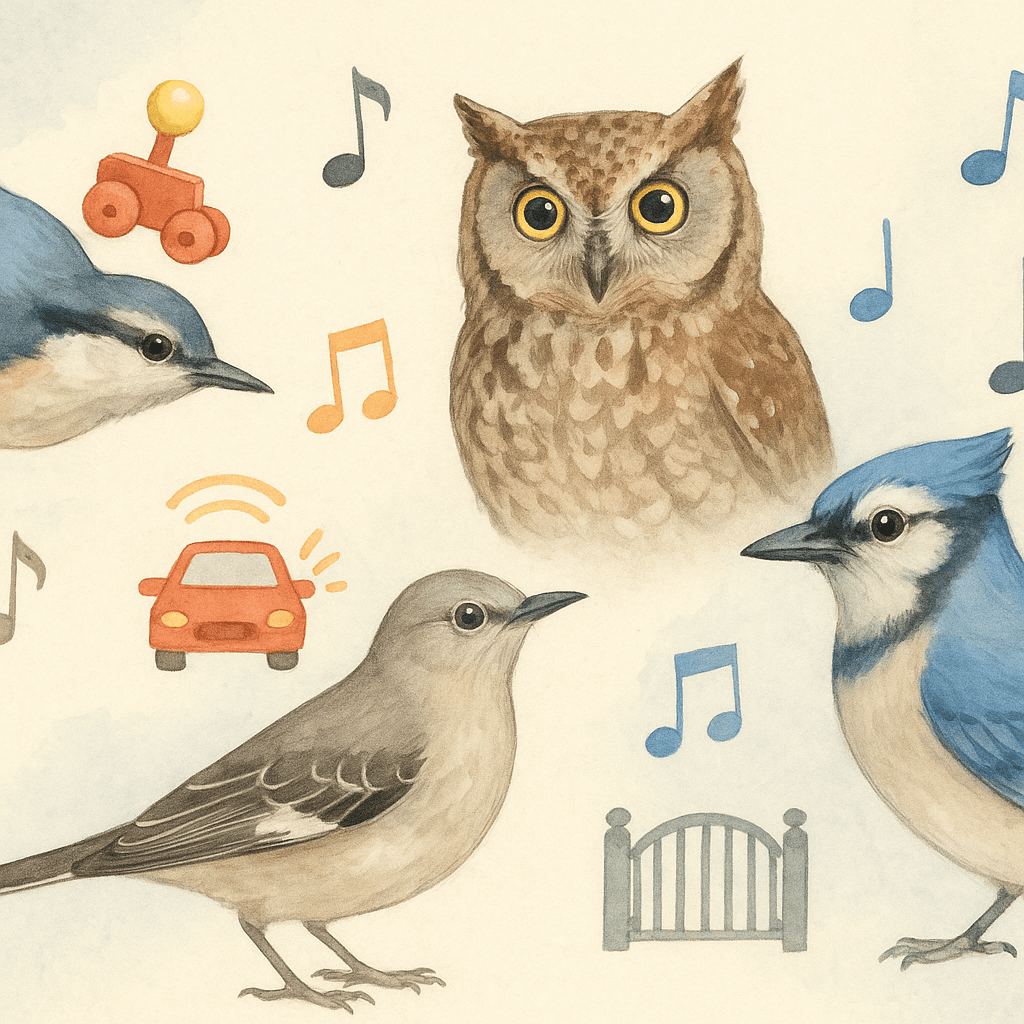
What Bird Sounds Like a Squeaky Toy (or Car Alarm)?
Meet 6 birds whose calls sound like everyday objects, from squeaky toys to car alarms to rusty gates.
Read Article →
If you have landed here, you are probably hearing weird bird sounds at night and trying to decide whether to call a mechanic, a ghost hunter, or a birdwatcher.
You are not imagining it. Nighttime acoustics are deceptive. Cool, still air lets high pitched sounds travel farther, and without traffic noise, every chirp, shriek, and whistle feels louder and more "mechanical" than it would at noon.
This guide is your late night decoder ring for the mystery sound outside your window.
Not sure the sound happened at night? Start with our full guide to weird bird sounds, which covers 11 of the strangest calls in North America, day and night. This page is the night shift specifically.
In Britain? The night cast is completely different, built around the Tawny Owl, the Barn Owl, and a robin singing under a streetlight. See strange bird noises at night in the UK.
You will learn how to:
If you want a broader overview of who sings after dark, you can also read: Why Are Birds Singing at Night? Meet the Night Singers.
| Sounds like... | Likely bird(s) | Where it happens |
|---|---|---|
| Squeaky toy / rubber duck | Brown-headed Nuthatch, Northern Saw-whet Owl | Southern pine forests, North American woods |
| Car alarm / beeps in sets of 3 | Northern Mockingbird, Red-winged Blackbird | Suburbs, marsh edges |
| Woman screaming / banshee | Barn Owl | Fields, farms, churchyards, marsh edges |
| Ping-pong ball bouncing / ghostly whinny | Eastern Screech-Owl | Woods and neighborhoods in eastern North America |
| Hypnotic name chant ("whip-poor-will") | Whip-poor-will, Chuck-will's-widow | Eastern and southern forests and clearings |
| Tiny high peeps from the sky | Nocturnal flight calls (warblers, thrushes, sparrows) | During spring and fall migration nights |
The rest of this article walks you through how to go from "it sounds like a squeaky swing" to "oh, that is an Eastern Screech-Owl yelling at the neighbor's cat."
Hearing it right now? Record a few seconds in Wings & Whistles and get likely matches on the spot. Get the app free →
Your brain is already doing something very useful: it is comparing bird sounds to everyday objects. Instead of fighting that, use it. Treat your first reaction as a clue.
Suspect 1: Brown-headed Nuthatch (Southeastern pine forests)
A small bird with a famous voice. Field guides routinely describe its call as "a squeaky rubber ducky" or "toy being squeezed."

Suspect 2: Northern Saw-whet Owl (North America)
A tiny owl with a surprisingly loud, pure too-too-too-too call. The name "saw-whet" comes from the idea that the call sounds like a saw being sharpened on a whetstone.
If it is a rapid series of pure squeaks from high in a pine stand, think nuthatch. If it is a steady, evenly spaced "truck backing up" sound in deeper woods, think Saw-whet.
For a deeper dive into the "squeaky toy" universe, check out: What Bird Sounds Like a Squeaky Toy (or Car Alarm)?
Prime suspect: Northern Mockingbird
Mockingbirds specialize in copying other sounds. They stitch together beeps, whistles, and buzzes in sets of repeated phrases, often singing through half the night, especially in suburbs and cities.
Listen for:

Red-winged Blackbirds and other species can also sound like "broken alarms" near wetlands, but they are mostly daytime voices.
Prime suspect: Barn Owl
Barn Owls do not hoot. They produce long, harsh, very eerie screams that many people mistake for a person in trouble the first time they hear them.

If your brain insists "this cannot be a bird," Barn Owl is highly likely.
Prime suspect: Eastern Screech-Owl
Despite the name, Eastern Screech-Owls are all about soft whinnies and trills.
Typical sounds:

They live in wooded parks, neighborhoods, and even city cemeteries in eastern North America.
Likely suspects: Blue Jay, Common Grackle, other day birds disturbed at night
Blue Jays can give squeaky pump handle and gate-like calls. Grackles and some blackbirds have metallic squeaks that feel more like machinery than birds.

Normally, you will hear these in daylight, but a roost that gets disturbed at night can erupt in industrial-sounding protests.
If the metallic squeak is what is bothering you, we go deeper on what bird sounds like a squeaky swing, including the rusty-hinge grackle and the small warbler people hear as a squeaky wheel.
Once you have a "sounds like" clue, the next filter is where you are and what the habitat looks like.
If you are hearing weird bird sounds at night in a neighborhood with lawns, shrubs, and streetlights, start with these:
Northern Mockingbird
Car alarm medleys, mechanical beeps, fast whistles, often from roofs or utility wires. Common in much of the United States, especially the South and mid-Atlantic.
American Robin
Rich, "cheerily-cheer-up" songs that sometimes extend into the night near streetlights. Urban robins are notorious for singing at odd hours because they are confused by artificial light.
Owls in the neighborhood


If the sound is melodic and complex, mockingbird or robin. If it is hooty or ghostly, owl.
Searches like "strange bird noises at night UK" often point to a short list:
Tawny Owl
The classic "hoo-hoo" and "ke-wick" combo. One bird may hoot while another answers with a sharp "KE-wick."
Barn Owl
That screaming, non-hoot voice mentioned earlier, hunting over fields and edges.
European Robin and Blackbird
Both can sing at night in lit urban areas. Robins have a sweet, fluid song; blackbirds sound like mellow flutes.
In a UK garden, melodic = robin or blackbird, hooty = Tawny Owl, unnerving scream = Barn Owl.
If the sound is coming from near water, especially in Florida, the Southeast, or marshy areas elsewhere, consider:
Limpkin (Florida and tropics)
Loud, wailing cries that sound surprisingly human.
Herons and Night-Herons
Abrupt, harsh squawks as they commute to or from roosts at dusk and night.
Rails and American Bittern
Virginia Rails, Soras, and American Bitterns are much more vocal at night. They produce "kid-ick" calls, descending whinnies, and booming "pump-er-lunk" notes.
If the sound feels prehistoric and comes from a pond or marsh, think herons, night-herons, or secretive marsh birds.
That classic rubber duck squeak drifting from pine canopies at night is almost always Brown-headed Nuthatch.
In forests and scrub of the Southeast and mid-Atlantic, also consider:
Chuck-will's-widow and Whip-poor-will
Nightjars that chant their names over and over, often for hours on summer nights.
These are prime suspects for "night birds in Florida" and "nocturnal birds near me" searches in the South.
If you searched your way here, you probably typed something very similar to these.
Likely answer: nocturnal flight calls
On migration nights, many songbirds travel high overhead and keep in touch with faint, high pitched calls. Thrushes, warblers, sparrows, and other species give simple "tseep" and "zeet" notes as they fly.
You might notice:
If the sound feels like little sparks of beeping drifting from the sky, you are probably hearing migration.
Likely answer: Eastern Screech-Owl
A long, steady trill held on one even pitch — like a soft mechanical purr from the trees — is the Eastern Screech-Owl's second signature sound, used between mates and around the nest. It can run several seconds, stop, and start again from a slightly different spot as the owl moves.
The classic impostor here is not a bird at all: gray treefrogs and trilling toads produce similar sustained trills on warm nights. Frog and toad trills tend to come from ground level or water and often overlap in choruses, while the owl's trill comes from up in a tree, one voice at a time.
Top suspects:
If you are near farmland or churchyards, Barn Owl jumps high on the list. In city gardens and parks, late night robins under streetlights are very common.
In Florida and much of the Southeast, your weird night sound might be:
If you are in a neighborhood: think owls and mockingbirds.
If you are near wetlands: think Limpkins, herons, and rails.
In North America, a true screech — short, squeaky, and hoarse, like a scream breathed in rather than out — is most often a young Great Horned Owl begging for dinner. The deep, measured hoots belong to the adults (that is the Great Horned Owl clip further up this page); the shrieking belongs to their teenagers. This owl nests in the dead of winter, so its enormous, fully feathered kids are still pestering their parents all summer, and they keep it up into autumn — sometimes as late as December. Listen for it from the same corner of the neighborhood night after night rather than one fixed branch, because the young trail their parents around the territory until they can hunt for themselves.
Length and inflection sort the two apart. A young Great Horned Owl's shriek is quick — half a second or less — and it slides up or down as it goes. A Barn Owl holds one long tearing shriek for a second or more on a flat, noisy rasp, like TV static snapped on and then off again, and it usually screams on the wing, so the sound crosses the sky instead of staying put in one tree. Barn Owls repeat themselves too, so do not count the screams — listen to the shape of a single one.
And the owl with "screech" in its name is the one least likely to be responsible. An Eastern Screech-Owl rarely screeches: its two everyday voices are the trill and the whinny above, and a true harsh screech is mostly reserved for adults defending a nest or fledglings. Which is why so many people who search for "screech owl" end up hearing something else entirely.
If it genuinely sounds like a person screaming:
Barn Owl screams are shorter and more obviously "from above," while fox screams tend to come from ground level and may be followed by barks or other fox noises.
Screams are their own rabbit hole: four different owls scream, and they scream very differently. For the full side-by-side, see what bird screams at night.
When in doubt, record it. Even if you never fully identify it, getting it out of your imagination and into a recording is strangely reassuring.
Night recordings are usually the messiest ones you will make: the bird is distant, the house is humming, and a car goes past at the worst possible moment. If your clip is buried under all of that, run it through our free Birdsong Isolator, which separates a recording into individual playable layers so the call is easier to actually hear.
Before you log everything in Wings & Whistles, remember that some of the weirdest night sounds belong to non-birds.
If it is a huge chorus of repetitive peeps from near water, frogs are a strong candidate. If it is one isolated, terrifying scream, think Barn Owl or fox.
You do not need special audio gear to turn "weird bird sounds at night" into something you can identify. Your phone is enough.
Open Wings & Whistles or your preferred recorder. A dark-mode interface helps you stay sleepy instead of blasting your eyes.
Ten to fifteen seconds of audio is plenty.
Wings & Whistles will suggest species based on your recording. When you confirm a match:
Over time, your collection becomes a personal gallery of the night singers you've encountered.
Use this article together with:
Wings & Whistles can suggest species based on the audio and your GPS location, then save each confirmed match as a card in your collection.
Over time, your collection becomes a personal field guide to the night singers in your area.
In North America, the most common answers are:
Other "toy-like" calls (including some warblers and jays) show up in the full squeaky toy guide.
In North America, a short, squeaky, hoarse screech repeated from the same corner of the neighborhood is usually a young Great Horned Owl begging to be fed, from spring right through autumn. A longer tearing shriek, flat and static-like and often given in flight, is a Barn Owl. Eastern Screech-Owls, despite the name, rarely screech: their everyday voices are a soft trill and a descending whinny. In the UK the screecher is almost always a Barn Owl, nicknamed the screech owl for exactly this reason.
If it is a full-throated scream rather than a rasp, compare all four screaming owls in what bird screams at night.
The Northern Mockingbird is the leading suspect. It copies other birds and environmental sounds, sometimes landing on a pattern that feels exactly like a car alarm cycling through different tones.
Near marshes, Red-winged Blackbirds and other blackbirds can also sound like broken alarms, especially at dawn and dusk.
Yes. Owls, nightjars, mockingbirds, and even some robins are all known to vocalize in the small hours, especially in spring and early summer.
If the sound is regular and repeats night after night, it is almost certainly normal behavior, not an emergency.
Use three quick checks:
You do not have to lie awake guessing.
Grab Wings & Whistles, capture the sound, tag it, and let your future self solve the puzzle. The night will still be full of strange voices, but they will belong to neighbors you recognize.
Start identifying mystery bird sounds Download Wings & Whistles Google Play
Meet 6 birds whose calls sound like everyday objects, from squeaky toys to car alarms to rusty gates.
Hear birds singing in the middle of the night? Learn why birds sing after dark and which species you're likely hearing.