Learning Journey
Learn Bird Songs by Ear: The Gentle 2-Week Method
Prefer a slower pace? The sibling plan teaches the same method across two weeks with themed days and softer rhythm.
Read Article →
Most bird-song guides give you two weeks, a curriculum, and a vague sense that you have signed up for school. This one gives you seven days, one bird per day, and a Sunday-morning walk where the names show up uninvited. You learn the way you learn a new commute — by doing it Monday, then again Tuesday, then again Wednesday, and by Thursday you have stopped checking the map. That is how this works.
Prefer a gentler pace? The gentler 2-week version walks you through the method itself with themed days and a softer rhythm. Same destination. Same seven-bird ceiling. Twice the runway. Or if you are not ready to commit yet and just want curiosity, start with 5 birds that sound like a laser and come back when the planner mood hits.
Quick honest note before we start: this roster leans eastern, because that is where most US backyard listeners live. Western readers, swap rules at the bottom of the post. The method does not change.
Ten minutes a day. Mostly passive listening, with one new song to anchor each morning. By next Sunday, you walk outside and they introduce themselves.
Seven days is not arbitrary. It is the smallest unit of time that contains a full weekly rhythm (the early-week willpower spike, the midweek slump, the weekend payoff), and it is short enough to actually finish before your motivation evaporates. (You know this already. It is the same reason most successful habit changes are framed as "just try it for a week.")
Seven birds is not arbitrary either. Cognitive research on category learning consistently lands in the five-to-nine range as the working-memory ceiling for new auditory categories before things start blurring together. Seven sits comfortably inside that window. Eight or nine and the catbird starts borrowing from the wren in your head; six and you under-fill the file cabinet you just built.
The honest caveat: this is the fast version. You will not be a fluent ear-birder by next Sunday. That takes months of casual exposure. What you will have is a seven-bird library, locked in well enough that you can name each one in the wild without hesitation. That library becomes the comparison shelf for every bird you meet for the rest of your life. (See the "from 7 to 30" section at the end. It compounds faster than you would think.)
Every day, the same three-step loop. Hear the bird's song twice — once eyes-open looking at the photo, once eyes-closed. Name it by attaching the mnemonic, out loud, like you are introducing yourself. Walkinto the next twenty-four hours expecting to hear it again, and when you do, name it before you check anything. That is the entire method. The two-week version teaches the theory behind why this works (mnemonics laundered through language, spaced repetition, the listening-first philosophy of putting ears before eyes). The seven-day version just runs the loop.
Monday is the warm-up. The American Robin is the bird you have been hearing your whole life without knowing it. Big rounded phrases, conversational rhythm, singing from a tall perch at dawn and dusk. If you have ever stood on your back porch in April and noticed a bird that sounds like it is gossiping with itself, that was a robin.
The mnemonic: "cheerily, cheer up, cheer up, cheerily, cheer up." Two- and three-syllable phrases delivered in packets, with brief pauses between. The pauses matter — that is how you tell a robin from a tanager (a tanager sounds like a robin with a cold, running everything together). Listen for the gaps as much as the notes.

Robin Day exists to prove the method works. You almost certainly already know this song — you just had not given it a name yet. By tonight, you have one locked in. (And tomorrow, when you hear it on the way to your car, your brain will do the thing. Just watch.)
Tuesday, pure tone. The Northern Cardinal is the cleanest whistle on the list: pure, repeated, almost flute-like, with a slight downward bend at the end of each phrase. Year-round resident across the eastern half of the country, which means you can practice this one in any season.
The mnemonic: pick one and stick with it. "Birdy-birdy-birdy." "Cheer-cheer-cheer." "Wheat-wheat-wheat-wheat." All three work. The listening tip that locks it in is the repetition rule: cardinals sing the same phrase three to eight times in a row before switching to a different phrase. That repeating pattern is your fingerprint. Robin moves on; cardinal hammers the same line.

(Quick fun fact you can drop at brunch: female cardinals also sing, which is rare among North American songbirds. Females sing mostly from the nest, often in response to the male. If you hear two cardinals trading phrases like a phone call, that is them.)
Wednesday introduces phrase structure. The Song Sparrow sings what is probably the most underrated song in your yard: three or four clear introductory notes on roughly the same pitch, a brief pause, then a buzzy trill that varies every time. The opening notes are the locked-in fingerprint. The back half is improvisation.
The mnemonic: "maids-maids-maids put on your tea-kettle-ettle-ettle." Long, slightly absurd, perfect. (Mnemonics work better when they are weird. "A clear song with a trill" is forgettable; "maids put on your tea-kettle" sticks for life.) The listening tip is to count the opening chirps before the song dissolves into the trill. Three or four clean notes, then everything else.

You are at the midpoint. Robin, Cardinal, Song Sparrow — three voices that cover the most common acoustic patterns in North American birds (conversational packets, pure repeated whistles, structured phrases). The next four are the harder ones. Trust the method. Let the 24-hour echo do the work.
Thursday, the first curveball. The House Wren does not sing in countable syllables. It sings in a falling, stuttering waterfall of notes that accelerates, trips over itself, restarts, accelerates again. There is no mnemonic that fits, and that is the point of Day 4: not every song fits in a phrase box.
(Officially the Northern House Wren since the 2024 taxonomy shuffle, but every birder you meet still just says House Wren. The split moved the southern populations into their own species; the bird in your backyard is the same one your grandparents knew.) The listening tip: describe the texture. A tiny stuttering waterfall. Jubilant and slightly chaotic. Once you have heard it twice, you will recognize the shape of the song even if you cannot transcribe a single note.

House Wren trains your ear for fast. After three days of slow-mnemonic birds, your brain wants every song to fit into a tidy phrase. This one breaks that habit on purpose.
Friday, the second curveball, and the most fun bird on the list. The Gray Catbird is a mimic in the mockingbird family: long, varied, improvised songs that sound like a medley of other birds played slightly wrong. The trick is that hidden somewhere in the medley, every minute or so, the catbird drops in its namesake call: a nasal, drawn-out meeeeew that sounds almost exactly like a housecat.
The listening rule: any song that sounds like a sloppy medley of other birds with an occasional cat noise mixed in is a catbird. That is the whole ID. Mockingbirds repeat each phrase three to six times before switching; catbirds say each phrase once and move on, which gives the song a hurried, half-remembered feel. The mew is the giveaway.

Catbird Day trains your ear for variable. Songs you cannot memorize phrase-by-phrase get filed by texture and signature instead. The texture: rambling medley. The signature: the mew. Two anchors, one bird.
Saturday, comfort food. After two curveball days, you have earned the most literal mnemonic in eastern birding. The Eastern Towhee says, with shocking clarity: "drink your TEA-eee." Two clear opening notes, then a musical trill on the third. Three syllables. Done.
The listening tip is habitat: towhees live in thick brushy edges — the messy strip where a yard meets the woods, the brambly hedge at the back of a park, the overgrown fence line. You will hear them long before you see them. They also have a sharp "chewink!" call that gives them their old folk name (Chewink). If a tea-drinking voice from the brush is followed thirty seconds later by a sharpchewink, congratulations — same bird, two vocabulary words.

Six down. One to go. By tonight you have a Sunday-morning roster waiting for you outside.
Sunday, the capstone, and your first warbler. The Common Yellowthroat sings a sharp, clipped "witchity-witchity-witchity-witch" from low cover near wet edges: ditches, marshy spots, the brushy bottom of a wooded slope. Three or four repeated phrases, hard consonants, no pretense.
The listening tip: yellowthroats are the warbler version of a towhee. Brush birds. You almost never see them out in the open; you hear the witchity from cover and that is the ID. (Bonus: if you do glimpse one, the male has a black robber's mask across his eyes, which is one of the easiest field marks in birding. A masked yellow-bellied bird in a wet ditch in May. Confirmed.)

This is also your handoff. You just learned your first warbler, which means the method works on migrants, not just resident regulars. Next week's lesson is this week's warbler roster, the rest of the warbler crew passing through your yard right now. Same method, new birds. The yellowthroat is your bridge species.
Saturday night, run the 60-second review. Pull up each bird's recording in order, say the mnemonic out loud as it plays, and move on. No quiz, no pressure. You are just warming the file cabinet.
Sunday morning, go outside before nine. Walk slowly — slower than your dog wants, slower than your watch wants. Stop every time you hear a bird. Try to name it before you check anything. Sometimes the name will arrive instantly. Sometimes you will stare at a hedge for thirty seconds trying to decide if that was a towhee or a song sparrow (the answer is the trill — towhee's trill is the back half, song sparrow's is the same). Sometimes the name will not come at all, and that is fine.
Permission slip: you will probably miss one or two of the seven this week. Catbird is the usual culprit because variability is hard. The fix is not re-studying. It is re-listening, once, that evening. The second exposure cements what the first one almost did. By mid-week two, the misses lock in.
That Sunday-morning walk is the test. After that, every walk for the rest of your life is a little louder and a little more populated. (You will find yourself naming birds in the parking lot at the grocery store. You will name a robin while putting out the trash. This is the door that opens once.)
The three most common failure modes, in order. You skip a day. Wednesday meeting ran late and you never opened the recording. Fix: do not restart from Day 1, just shift the schedule one day to the right. The bird you skipped becomes a bonus passive exposure on the day you resume, which actually helps.
You confuse two birds. Day-3 Song Sparrow and Day-6 Eastern Towhee both end in a trill, and on Sunday morning the towhee in the hedge sounds suspiciously like a song sparrow. Fix: a 60-second A/B. Pull up both recordings, play them back-to-back twice, and listen for the front half — towhee says "drink your," song sparrow says "chip-chip-chip." The trills are similar; the openings are not.
The catbird breaks your brain. Day 5 lands and you swear it sounds like every other bird in your yard played on shuffle. That is because it does — you got the bird. Fix: trust the mew. If you hear a rambling medley with a cat noise in it, it is a catbird. Stop trying to decode the medley.
The general rule is the same in every failure mode: exposure beats effort. Re-listen, do not re-study. Let the song play in the background while you do something else. The brain does the filing automatically — your job is just to put the file in front of it again.
Here is what nobody tells you until it happens: once seven songs are locked in, the next twenty come three times faster. Because now you have a comparison library. New bird?"Sounds like a robin but quicker." "Reminds me of a towhee, but the trill is in front." You can describe sounds in terms of sounds you already know, which is how every birder over forty actually thinks.
The natural next step is the warbler wave currently rolling through your yard. Spring migration peaks mid-May, and this week's warbler roster is the perfect application of the method you just learned. Common Yellowthroat is the bridge bird, and the rest of the warbler crew (Yellow Warbler, American Redstart, Black-throated Green) clicks into place fast.
For the broader arc, our guide to the broader spring migration arc walks the eight-week season from March's opening notes to May's dawn-chorus crescendo. For the year-round resident expansion, the GBBC backyard 10 is the next plateau: ten resident voices that pair with your seven to give you a twenty-bird working library.
Or, if you want a curiosity-driven on-ramp instead of another structured plan, drop into 5 birds that sound like a laser and chase the weird ones. The method is the same. The roster is just stranger.
These seven are the regulars, the voices that show up week after week in your yard, the ones that introduce themselves once you know their names. The rarities come next: the warblers in passage, the one-week migrants, the strangers you only hear in May. Same method. Different rhythm.
Wings & Whistles Learning Journeys are the on-rails version of this plan: short audio-first lessons with the mnemonics built in, paced one bird per day.




Yes, you can learn seven common bird calls in 7 days at a beginner-recognition level, if you commit ten minutes a day to one new bird per day. You will not become a fluent ear-birder in a week, but seven days is enough to lock in a working backyard library. The trick is one bird per day, the same bird heard at least twice in twenty-four hours, and a mnemonic that turns the song into language. Real fluency builds across months of casual exposure after that first week.
The 2-week plan teaches the method itself, with themed days and a gentler rhythm. This 7-day plan applies that same method at double speed, with one bird per day and a Sunday-to-Sunday window. Both arrive at roughly the same place. Pick the 7-day plan if you want urgency and a clear finish line. Pick the 2-week plan if you want to understand why the method works before you commit to it.
Do not restart. Pick up on the next available day with the bird you skipped, then continue from there. A missed day is not a failure of the plan, it is a recovery test. The bird you missed becomes a bonus exposure on day N plus one, and the spaced repetition actually helps. Most people miss at least one day and still finish with all seven locked in by the second Sunday.
Any quality recording works. The Macaulay Library, the Cornell Lab, and most birding apps have reliable audio for every species in this plan. Wings & Whistles bundles the recording, the mnemonic, and a spaced-repetition prompt into one tap, which is the convenience tax for skipping the manual setup. The method does not depend on a specific app, but it does depend on hearing the same song twice in twenty-four hours.
Keep Robin, House Wren, Song Sparrow, and Common Yellowthroat as written, since all four are continental. Swap Eastern Towhee for Spotted Towhee, which is a drier, faster cousin that often skips the clear opening notes and jumps straight to the trill. Swap Northern Cardinal for Black-headed Grosbeak in the far west, which has a richer warbled song and a softer mnemonic match. Swap Gray Catbird for Bewick's Wren, which gives you the same brushy edge habitat with a clean three-part song instead of a mimic.
Pick a category that excites you and chase it for the next month. Spring migration brings warblers, thrushes, and vireos through most of the US in May, and the warbler roster pairs perfectly with the method you just learned. Year-round, the next twenty backyard birds come three times faster than the first seven because you have a comparison library now. Every new song gets filed against ones you already know.
Open any bird for its recordings, what to listen for, and the birds it gets mistaken for.
Start the 7-day plan in the app. Voices that stay with you. Download Wings & Whistles Google Play
Prefer a slower pace? The sibling plan teaches the same method across two weeks with themed days and softer rhythm.
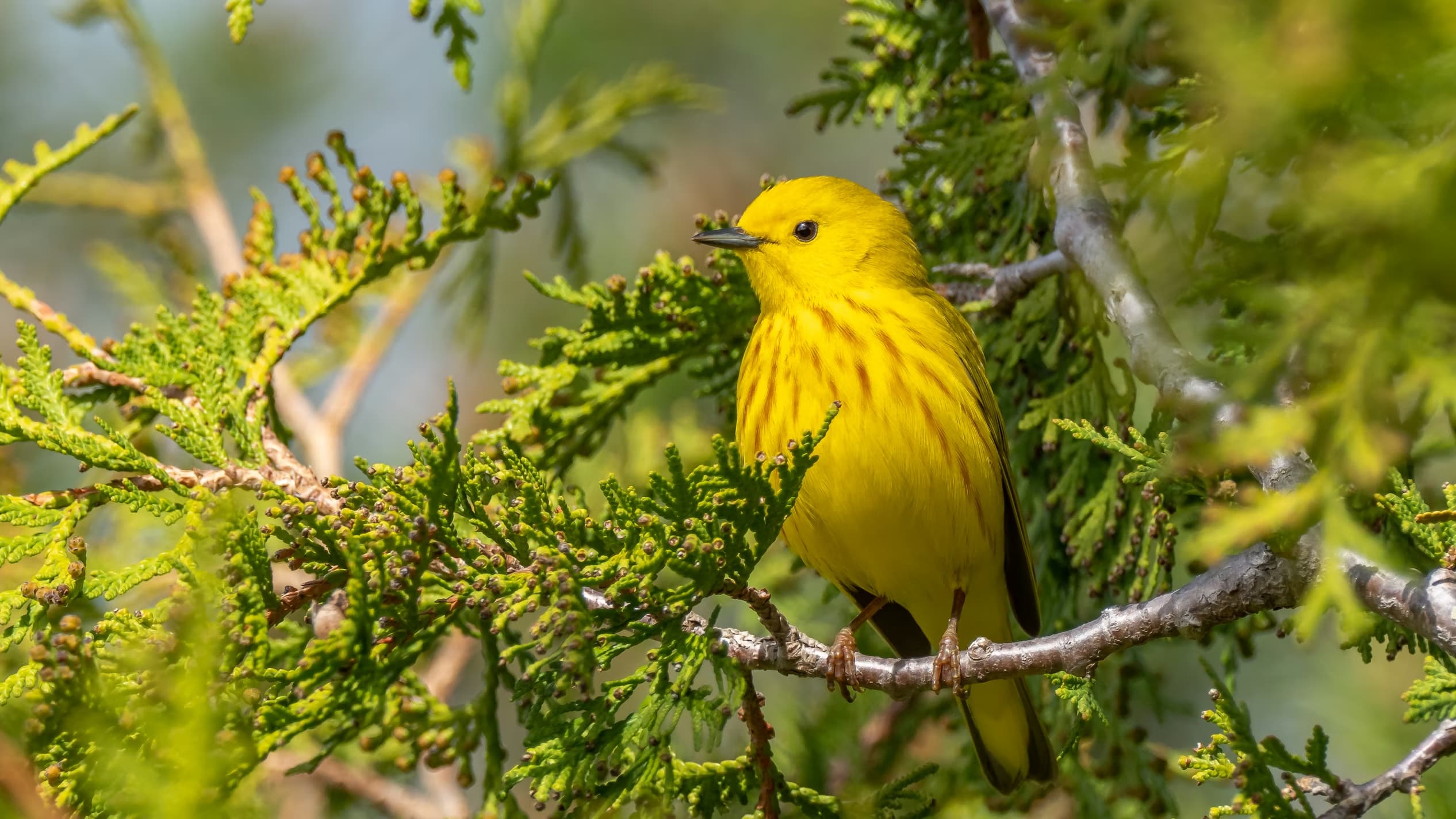
Common Yellowthroat is your bridge bird. Pick up the rest of the warbler crew rolling through your yard right now.