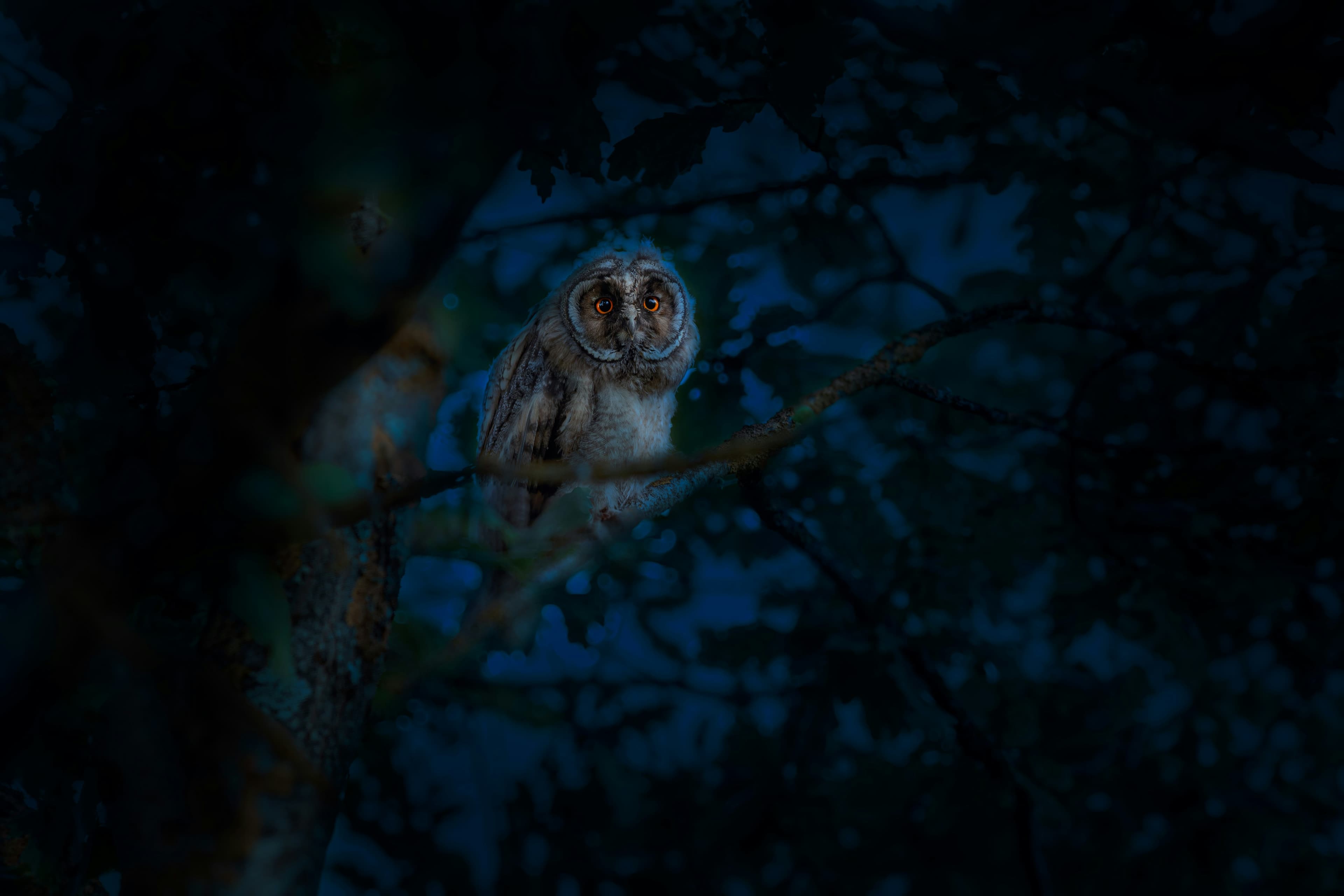
Night Sounds
Weird Bird Sounds at Night (North America)
The American lineup: screech-owls, mockingbirds, and the rest of the after-dark cast, matched to what you actually heard.
Read Article →

Good news: it is almost certainly an owl, a fox, or a robin who has been fooled by a streetlight. The British night has a small cast of regulars, and once you have met them, the 1am shriek stops being a horror-film sound effect and becomes something closer to a neighbour you can name.
This is the UK lineup, sorted the way you actually hear it: by the shape of the noise, not by the Latin name.
In North America? The cast is completely different over there (screech-owls, mockingbirds, whip-poor-wills). Read Weird Bird Sounds at Night for the American lineup instead.
If you want the shortest possible version: hoots are owls, screams are usually foxes or Barn Owls, and anything that sounds genuinely musical at 2am in a town is a robin who thinks your streetlight is the sunrise.
Hearing it right now? Record a few seconds in Wings & Whistles and put a name to the noise, then let the lessons make the next 1am shriek arrive with a name already attached. Get the app free →
Standing at the window in the dark, you do not need a species name yet. You need a bucket. Almost every strange British night noise falls into one of four, and picking the right one cuts the suspect list from dozens to about two.
Height beats everything. Before you try to remember what the noise sounded like (memory is a terrible witness at 1am), ask where it was in the air.
That one question, sky or perch or ground, solves more night mysteries than any amount of squinting into the dark.
This is the one you have heard your whole life without knowing it. Every British woodland scene on television, every Halloween sound effect, every spooky hoot in a radio drama: Tawny Owl. It is Britain's most numerous owl, somewhere around 50,000 pairs, and the single likeliest bird behind a hoot in the dark — from a Speyside pinewood to a Birmingham park with a few big trees in it. Trees are the whole condition. No trees, no Tawny: the BTO has it absent from Orkney, Shetland and the Outer Hebrides, and from treeless upland ground generally, particularly in northern Scotland.
And there is one gap that surprises everybody: the Tawny Owl does not live in Ireland at all. It never made the crossing. So a hoot in Belfast or Cork is not a Tawny — it is almost certainly a Long-eared Owl, Ireland's default owl, whose male hoots low and soft, like someone blowing across the neck of an enormous bottle. And if you hear a rusty gate swinging in a dark conifer in June, that is not a gate. That is a hungry Long-eared chick.
The male's hoot is a long, quavering hoo... hoo-hoo-hoooooo, breathy and hollow, with a wobble at the end like a note played slightly nervously. It carries a remarkable distance, which is why it always sounds like it is coming from somewhere just outside your fence and is often three streets away.
Here is the fact that reorganises the whole thing in your head: no single owl says twit-twoo. What you are hearing is two birds. The female makes a sharp, cutting ke-wick! and the male answers with the hooting hoo-hoo-hoooo. Put a pair in the same wood on an autumn night and your ear stitches their duet into one bird saying twit-twoo, which is a lovely bit of accidental karaoke and completely wrong.
Once you know it is a duet, you start hearing the gaps, the answering, the two different voices in two different trees. It is one of the great little upgrades in British birding-by-ear (and you get it for free, tonight, from your own bed).
We only publish recordings we hold the rights to, and we do not have a licensable Tawny Owl recording yet — so rather than fake one, we are telling you. The two voices to listen for are described above: the male's wavering hoo... hoo-hoo-hoooo and the female's sharp ke-wick. The clips further down (Barn Owl, Robin, Starling) are all real, and the Tawny is distinctive enough that the descriptions will carry you until we add its clip.
Tawny Owls sort out their territories from late summer onwards, and the racket peaks roughly September to November as young birds go looking for a patch of their own and the residents tell them exactly where to go. If your neighbourhood suddenly acquired an owl in October, this is why.
Go and stand in the garden for five minutes after dark this week. If you are anywhere in wooded Britain with big trees within a few hundred metres, the odds are good there is a Tawny Owl holding territory in them, and you have simply been sleeping through it. (If you are in Ireland, or out on treeless upland ground, that hoot is something else — see above.)
If the noise that woke you was genuinely frightening, this is your bird. The Barn Owl does not hoot. It shrieks: a long, rasping, drawn-out scream, closer to tearing fabric than to anything you would call a bird call. Deliver that sound over a dark churchyard at 1am and you have the entire British ghost tradition in one go.
Play it once and it will sit in your memory permanently, which is exactly what you want. This is not a sound you will ever second-guess again.

Rough grassland, farmland edges, quiet lanes, old barns, and yes, churchyards. Barn Owls hunt low over verges and field margins, and they are far more likely on the edge of a village than in the middle of a city. If you live in a terraced street in Leeds, your midnight scream is much more likely to be a fox (see below). If you live where there are voles, it may well be this.
Late summer is the noisiest window. Well-grown Barn Owl chicks sit in the nest hissing and snoring for food like a slowly deflating radiator, hour after hour, and it sounds deeply unwell. It is not. It is just teenagers.
The split is the whole game: hoot = Tawny, scream = Barn. Two owls, two totally different sounds, and about ninety percent of the confusion in British night birding lives in that one gap.
Two owls down. Learn the rest of the UK night shift by ear, a few minutes at a time. Download Wings & Whistles Google Play
Here is the answer most people actually need. If what you can hear at 2am is not scary at all, if it is tuneful, wistful, a proper little song with phrases and pauses, and if you are in a town, it is a European Robin. Not an owl. Not a nightingale (sorry). A robin, sitting somewhere near a light, singing its head off at an hour when it has absolutely no business doing so.

The song is thin, silvery, and slightly melancholy, running in loose phrases that trail off and start again, as if the bird keeps losing its thread. In the small hours, with no traffic and no other birds competing, it carries astonishingly far. People routinely mistake it for a nightingale, which is a bit like mistaking your postman for a film star: flattering, geographically unlikely, and easily settled by looking at where you live.
A few reasons stack up, and towns supply all of them at once:
If the whole idea of after-dark singing intrigues you, we go deeper into it in why birds sing at night, and the flipside, why they all go off at once at first light, is in the dawn chorus. (Do check the clock, by the way. A June “night” singer at 3:30am may simply be an ordinary bird starting an ordinary very early day.)
Some night noises do not sound like birds at all. They sound like a phone ringing in an empty street, or a car alarm two doors down, or something electronic with a flat battery. That is a European Starling, and it is having a wonderful time.

A starling's song is a rambling, unstructured stream of clicks, whistles, rattles, wheezes and rude little squeaks, delivered with total commitment and no discernible tune. Threaded through it are impressions: other birds, ringtones, alarms, lawnmowers, a squeaky gate. They are superb mimics and completely shameless about it, which is why starlings are behind so many “there is a bird outside doing a car alarm” searches.
Starlings are a dusk-into-dark bird, not a 3am bird. Town-centre roosts gather in the last light, pile into a lit-up building, a pier, a car park, a plane tree, and keep chattering well after the sky has gone dark, especially where streetlights keep the whole thing half-lit. If the noise arrives with the evening and fades away, this is your bird. If it starts up at two in the morning in complete darkness, look elsewhere on this list.
Numbers. One robin sings alone. A starling roost is a crowd, a hundred conversations at once from a single tree or building, and it sounds far more like a machine than an animal.
For daytime versions of this puzzle, our UK squeaky-toy guide covers the small, oddly mechanical garden sounds that get mistaken for toys and bike pumps.
Two of the most-reported night noises in Britain are not on anybody's owl list, because they only turn up for a few weeks a year and then vanish. If your mystery noise is seasonal, start here.
If you live in a town with flat roofs and chimney stacks, and the racket above your bedroom is a loud, raucous, repetitive yelping that goes on and on, that is a Herring Gull or a Lesser Black-backed Gull. Rooftop colonies are now a fixture of coastal towns and plenty of inland ones too, and a gull's long call at close range is less a bird sound than a public announcement.
It peaks in June and July, when there are chicks on the roof: the adults are noisy, defensive, and perfectly happy to forage under streetlights and yelp through the small hours. There is no subtlety to it and no mystery once you have identified it. There is also, regrettably, no snooze button. (If the noise stops dead in August, you have your answer: the chicks fledged.)
This is the loveliest sound in this entire article, and the one most people never learn. On clear nights in October and November, step outside, stand still, and listen up. Every so often a thin, high, slightly wistful tseep drifts down out of the blackness, unrepeated, moving.
That is a Redwing: a small thrush arriving from Scandinavia and Iceland, flying over your house in the dark, keeping in contact with the rest of its flock. Thousands cross the country on a good thrush night. The key detail is that the sound comes from the sky, not a tree. If your mystery seep is moving overhead and never repeats from the same spot, nothing in your garden made it.
Learn that one call and autumn nights stop being empty. (This is the moment a lot of people quietly become birders. Consider yourself warned.)
A large share of “strange bird noises at night” searches in the UK are not about birds. They are about mammals, and the sound in question is usually genuinely horrible.
A vixen's scream is one of the most alarming noises in Britain: a hoarse, drawn-out, almost human shriek, and if you have never been told what it is, you will absolutely consider phoning the police. People do, every year. It is a fox, standing on the pavement outside, screaming.
Two clues settle it fast. First, it comes from ground level, from behind the bins, from the alley, from the middle of the road. Owls call from height. Second, it usually arrives with company: the fox's other calls are a sharp triple bark, wow-wow-wow, thrown across the gardens like a rusty question.
Timing: you will start hearing it in autumn as young foxes disperse, but it ramps up into winter and peaks in the mating season, roughly December to February. If your street is being screamed at in January, that is foxes, and it will stop of its own accord in a few weeks.
Routine hedgehog noise is comic rather than sinister. They snuffle, huff, snort, and grunt like a small pig working its way along the border, and courting pairs can circle and huff at each other for hours. If your late-night noise is a busy, snorting rustle low in the undergrowth, that is a hedgehog going about its business and you can go back to sleep, delighted.
A hedgehog scream is not background noise and it is not a charming mishearing. It is a distress call: a hedgehog that is injured, trapped, or in immediate danger, from netting, a strimmer, a drain, a dog, or a bonfire. If you hear a high, repeated screaming from ground level, take a torch and go and look. A hedgehog out in daylight, lying flat, wobbling, or obviously hurt needs help too.
Contain it (a high-sided box, an old towel, gloves), keep it warm and quiet, and ring your local wildlife rescue or the British Hedgehog Preservation Society for the nearest carer. This is the one noise on this page where the right response is to get out of bed.
A thin, high squeak is a different animal from a scream, but the same trick sorts it out: where was it?
From ground level, in the border or the long grass, your likeliest squeaker is a shrew. Common shrews are furiously territorial, and two of them meeting in a hedge bottom on a summer night set off a burst of needle-thin squeaking right at the top edge of human hearing. Which is why your children can hear it and you might not. Hedgehogs squeak far less than their reputation suggests. The famous courtship racket is the female huffing and snorting at an over-keen male, not squeaking. A hedgehog that is genuinely squeaking or squealing is usually frightened or hurt, so treat it like the scream above.
From a roofline at dusk, an excited, high twittering from under the tiles or soffits may not be a bird at all. Pipistrelle bats chatter before they emerge, and their social calls are just audible to children and people with sharp ears. From a tree on a summer night, a wheezy, repeated squeak, a bit like an awkward kiss, is a young Tawny Owl begging to be fed, night after night from June onwards.
Squeaking in broad daylight from a hedge is almost certainly a tit, and our UK squeaky-toy guide has that one covered.
Everything else out there is mostly background: badgers yickering, cats disagreeing at length, muntjac barking in southern counties, and the occasional startled blackbird going off like an alarm because a cat walked under its roost.
You do not need to learn two hundred species. The British night has about five voices you will hear again and again, and you can get on terms with all of them in a couple of weeks of not really trying.
Think of it as two lists. The regulars, Tawny Owl and Robin, you will hear most weeks once you are listening, and they are the two to learn first. The rarities, the Barn Owl shriek and the October Redwing seep, may only turn up a few times a year, but they are the ones you will remember for the rest of your life, because you will finally be able to name them.
If you want a structure for it rather than a hope, our gentle two-week method for learning bird songs by ear works exactly as well on owls as it does on garden birds. Ten minutes, one bird, repeat.
The Barn Owl is the screaming bird of the British night: a long, harsh, rasping shriek, most likely near farmland, barns, and churchyards. If the scream came from ground level rather than from height, though, it is much more likely to be a fox.
The Tawny Owl. Its wavering hoo-hoo-hoooo is the classic British hoot, and it is loudest from September to November when territories are being settled. The famous “twit-twoo” is actually two birds: the female's sharp ke-wick answered by the male's hoot.
In a UK town, a genuinely tuneful song after dark is almost always a European Robin. Daytime noise is the main driver: robins in the noisiest daytime spots are the ones that shift into singing at night, and streetlights add to it. They also defend their territory year-round, so they sing in winter too.
Ask where it came from. A fox screams from ground level, often near bins, alleys, or the road, and frequently follows up with a triple wow-wow-wow bark. A Barn Owl shrieks from height, in flight or from a perch, and is far more likely in open countryside than in a terraced street.
That is a European Starling. Starlings are expert mimics of car alarms, ringtones, and machinery, and their town-centre roosts chatter on well past dusk under streetlights. They are a dusk-into-dark bird rather than a middle-of-the-night one.
Record twenty seconds on your phone from an open window, and write down one word: sky, perch, or ground. Compare it against a known recording in the morning, when your ear is fresh and the panic has worn off. Start with the two regulars, Tawny Owl and Robin, because those are the ones you will get repeat chances at. The Barn Owl shriek and the October Redwing will find you on their own schedule.
Open any bird for its recordings, what to listen for, and the birds it gets mistaken for.
Start learning UK night birds by ear Download Wings & Whistles Google Play
The American lineup: screech-owls, mockingbirds, and the rest of the after-dark cast, matched to what you actually heard.
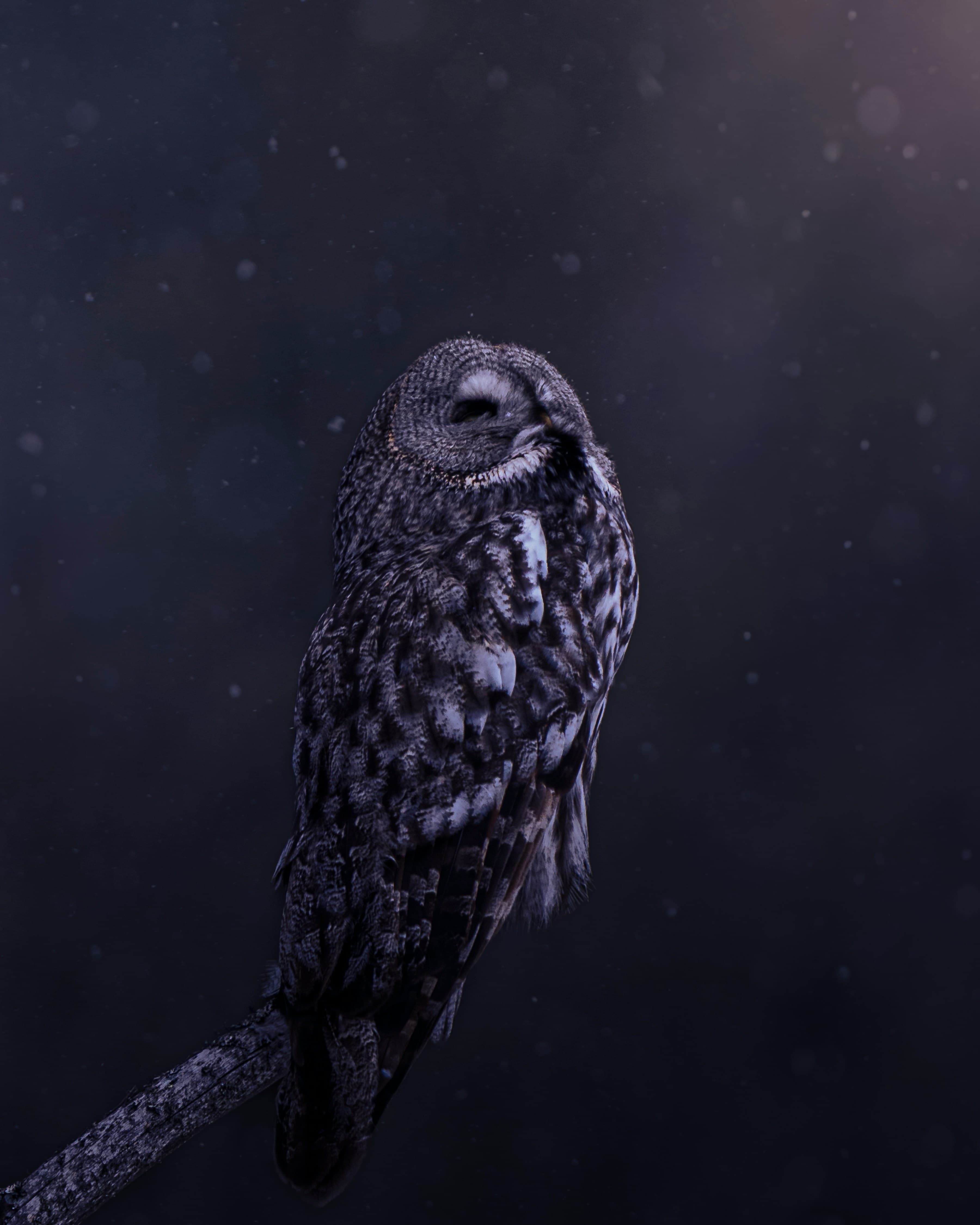
Streetlights, quiet streets, and winter territories: why some birds sing after dark, and which ones you are hearing.