
Learning Journey
How to Learn Bird Calls Fast: A 7-Day Spring Plan
The ear half of the practice loop: a week-long plan to get the songs into your head before you try to whistle them out.
Read Article →
That moment is the whole hook of learning to whistle bird calls, and the good news is that it is a skill, not a gift. It breaks into parts you can practice one at a time: hearing the song properly, landing two notes, keeping a rhythm, sliding, holding, using your hands, and finally using your voice. This post walks that ladder from the easiest whistle to the hardest, with a real recording on every rung so you hear the target before you try it. A quick note on geography: these six are eastern backyard regulars. Out West, swap in your local chickadee and dove, and the techniques carry over unchanged.
Here is the method in one line: listen until you can hum it in your head, then whistle. Most people skip the first half, blow something vaguely birdy, and wonder why nothing answers. Your mouth can only copy what your ear has already pinned down, so the ear goes first, every time.
When you listen, you are listening for three things. Pitch is how high the note sits. Interval is the size of the gap between two notes, a small step or a big leap. Rhythm is the timing, how long each note lasts and how much silence sits between them. Of the three, pitch is the one you can fudge. Your whistle will come out lower and a little rougher than the bird's, and that is fine. Birds seem to care more about the shape of a song, the gap and the timing, than about hitting the exact note, so get the shape right and the rest is polish. If you want a gentle on-ramp for the listening half, our two-week method for learning bird songs by ear is the place to start.
One distinction worth making up front. Mnemonics help you remember a song; this post is about making one. So you won't find catchy phrases here, just the shape of each sound and how to get your lips around it.
The mechanics, in four lines. Pucker as if you were about to blow out a single birthday candle. Rest the tip of your tongue low, just behind your bottom teeth. To go higher, slide your tongue up and forward so the space in your mouth gets smaller. To go lower, drop your jaw and let your tongue sink. That is the whole instrument. Everything below is learning to play it.
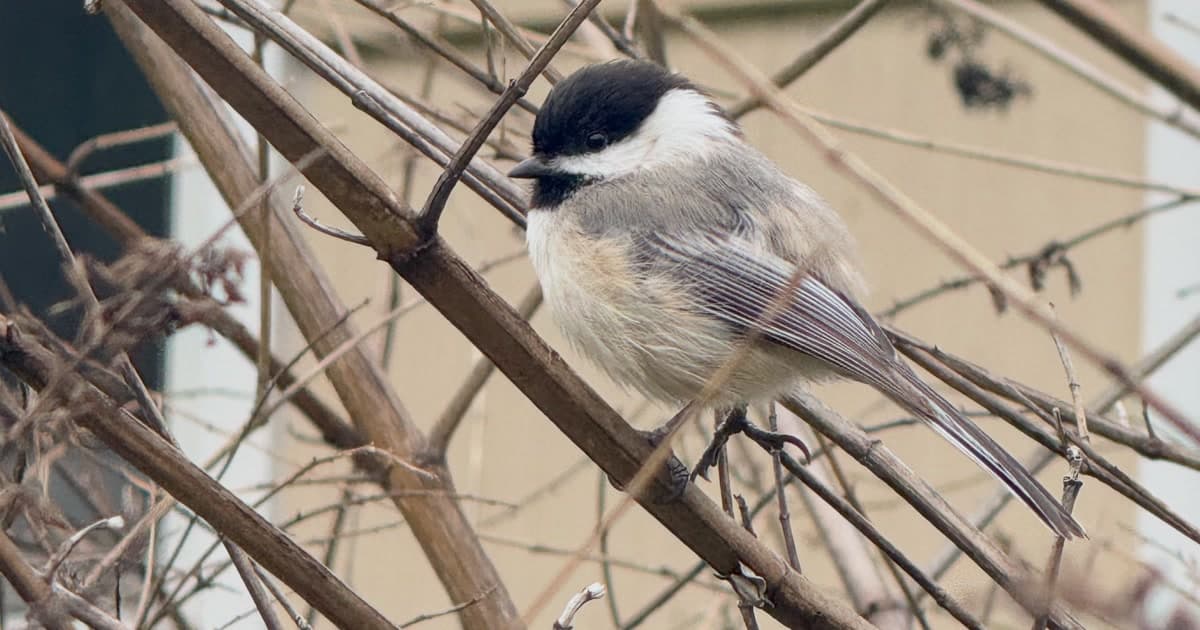
Interval is the first thing to get right, and the chickadee's two-note song is the cleanest interval lesson in the backyard. One steady note, then a second note a small step lower. No slide between them, no wobble, no ornament. Two pure tones, like someone tapping two neighboring keys on a glockenspiel.

The drill: whistle the first note by itself five times, until it stops wavering. Then add the drop. The trap is sliding, letting the pitch smear down between notes like a sigh. Stop the air for a hair between them if that helps, then shrink the gap until the two notes sit side by side without touching.
Here is the detail that makes this bird such a good teacher. A chickadee doesn't sing its song at one fixed pitch. Different birds, and the same bird on different days, pitch it higher or lower, but the gap between the two notes barely changes. The bird is keeping the interval, not the key. Which is excellent news for you, because the real thing sits right up at the ceiling of most people's whistle. If yours squeaks out up there, drop the whole song lower and keep the gap the same. You are doing exactly what the bird does.
Southeastern readers: your chickadee is probably the Carolina Chickadee, which sings a four-note version that doubles up the pattern. Same drill, just run it twice. And for everyone, a seasonal heads-up: chickadees sing much less in October than in February, so your practice audience is smaller right now. That is no bad thing. You get to rehearse before the crowd shows up in late winter.
Once two notes come out clean, the next job is to repeat them without losing the shape. The Tufted Titmouse takes a two-note whistle, much like the one you just learned, and fires it off several times in a row at a steady clip. Same interval skill, now with a metronome running.

The new technique is tonguing. Instead of stopping your breath between each pair, keep the air flowing and touch your tongue lightly behind your lips, a soft "too-too, too-too," so the notes separate while the airflow never quits. Flute players do this all day. It is the difference between a phrase and a string of gasps.
The drill: tap your foot to set a tempo, then whistle the pair on every tap, all on one breath. Aim for four repetitions, then six, then eight. You will run out of air around repetition five. The titmouse, which weighs about as much as four quarters, will not, and it will look at you with those big dark eyes as if it has no idea what the problem is. Keep your breath low and steady, spend it slowly, and don't let the tempo drift faster as you go (that is the tell of someone about to run dry).
Set expectations for the season, too. Titmice will still toss out a run of whistles on a mild fall morning, just not with springtime enthusiasm. Song peaks from March through May, so if you get an answer in October, count it as a bonus.
Up to now, every note has mostly held still and the drama has lived in the jump between them. This rung lets the pitch move inside a note, and you'll need your rung 2 breath control, because the Northern Cardinal strings these moving notes together one after another. Its song is a loud, clear string of whistles. Listen closely and each whistle comes as a quick pair of notes, and neither note sits still: each one swoops up and spills back down in a little arch. The cardinal fires off a string of these pairs, often speeding up at the end.

Listen to the clip a few times before you try anything, and follow a single note with your ear. Where the chickadee's notes sat level, each of these climbs and tips over the top in one breath, like a tiny rainbow. Then notice they arrive in pairs. Movement inside each note, pairs between them: that is the whole ear lesson of this rung. (Cardinals carry a whole repertoire of song types, so the one in your yard may switch to long single down-slurs some mornings. Same slide, just one direction.)
For the slide, the technique is to keep the air moving while your mouth changes shape under it. Start the note, slide your tongue up and forward to lift the pitch, then drop your jaw and let your tongue relax back so it falls: up and over, one smooth arch. The classic mistake is flattening each note, landing on two flat notes the way you did in rung 1, instead of two arches. If you hear a staircase instead of a ramp, slow it way down and make one arch take a full second. Then put two arches back to back with a light rung 2 tongue-tap between them, and repeat the pair three, four, five times, quickening toward the end of the string the way cardinals often do.
A nice aside for practice sessions: female cardinals sing too, which is unusual among North American songbirds, and a female may even sing from the nest. So if the bird whistling back at you is the warm brown one rather than the fire-engine red one, you are not imagining it.
After a rung of letting the pitch slide, the harder discipline is keeping it from moving at all. The White-throated Sparrow sings long, pure, held whistles that sound almost wistful. Hold a note flat, then jump cleanly to a new note (no slide) and hold that one flat too, then finish with a quicker run of short notes. Steady, jump, steady, flutter. Notice that the jump is your rung 1 skill and the flutter is your rung 2 tonguing. The new part is the long, level hold.

Holding a whistle steady is a breath job, not a lip job. Breathe low, into your belly, and let the air out at an even pressure, the way you would blow on soup you don't want to splash. Keep the pucker relaxed; a tight pucker wobbles. The drill: open a free tuner app on your phone (or just a voice memo) and whistle one long note for two seconds at it. If the tuner needle swims, your breath is uneven. Get it to sit still, then add the jump and a second steady note.
And here is the most encouraging fact in this post. White-throated Sparrows are arriving in backyards and brushy edges across the East right now, and they do sing in fall. But listen closely and some of those songs are shaky, cut short, or a little off, because first-year birds are still working theirs out. Even the birds are practicing. You are in good company.
Your lips have now done everything they can: steps, rhythm, slides, and holds. But some birds sound low and hollow in a way a puckered whistle can't reach. For those, you build a little chamber out of your hands and blow across it, the same way you get a note out of an empty bottle. The classic target is the Mourning Dove: a soft opening coo that swoops up and sags back down, then three long, lower coos.

Build the chamber. Cup one hand loosely, palm up. Lay the other hand across it so the fingers wrap over the back of the bottom hand and the palms form a hollow space inside, sealed all the way around. No gaps along the sides or bottom.
Make the mouthpiece. Bring your thumbs together, side by side and parallel, and bend them slightly at the first knuckle. That leaves a small gap between the thumbs just below the knuckles. That little opening is where the sound happens.
Blow down, not in. Rest your top lip on the top of your thumb knuckles and blow a thin stream of air down across the gap, as if it were the mouth of a bottle. Do not blow straight into your hands like you are warming them up. The air needs to split on the far edge of that gap. When it catches, you will get a soft, breathy hoot.
Change the pitch. Lift the fingers of your back hand to open the chamber and the pitch rises; close them down and it falls. That is your rung 3 slide again, done with fingers instead of your jaw, and it is exactly how you get the dove's swoop on the first coo. Open as you start it, close as it sags, then hold the hands still for three long, lower notes with the same steady breath you built in rung 4.
Troubleshooting. All air and no tone almost always means a leak around the palms, so squeeze the seal tighter. If the tone flickers in and out, adjust the angle of your lip on the knuckles a few millimeters at a time. Bone-dry hands don't seal well either; slightly damp palms help.
An honest aside: expect about ten minutes of blowing air into your hands before the first real hoot, while everyone in the house wonders what you are doing. That is normal. Once it clicks, it stays clicked, and it is a fun one to teach kids on a walk. Doves coo year-round, though you'll hear the song less in fall than in spring, so the yard may be quieter than your practice sessions.
The hand whistle got you low and hollow. The last rung goes lower still, and here the whistle stops entirely. The Barred Owl is a voice sound. You make it with your throat and chest, not your lips, and two of your earlier skills show up in it.

Relax your throat as if you were about to yawn. Drop your voice into the bottom of its range and shape round "hoo" vowels, letting them resonate in your chest. The rhythm is your rung 2 skill: the owl's hoots come in a set pattern of short and long notes (you probably know the phrase already, and we won't make you memorize it again here). Then, at the very end of the phrase, let the last note sag down into a drawn-out "aww." That is your rung 3 slide, now in your voice.
The good news for beginners: rhythm matters far more than tone here. A slightly goofy hoot with the right timing reads as Barred Owl; a gorgeous hoot with the wrong timing reads as a person in the woods. Practice it indoors, in the car, into a voice memo. Before you try this one outdoors after dark, though, read the next-but-one section. This is the sound on the ladder most likely to get a real answer, which is exactly why it comes with rules.
Six rungs in, you can control interval, rhythm, slide, and hold. That is the right lens for judging the gadgets people shop for when they search for a bird whistle.
The best known is the Audubon-style twist call, a little wooden cylinder with a metal plug that squeaks and chirps when you twist it (Roger Eddy dreamed up the original in 1947, and it has barely changed since). It does work, but not the way people hope. It doesn't make any particular bird's song. It makes generic squeaks and chirps that sound a bit like a small bird in distress or in a mood, and curious songbirds, chickadees and titmice especially, will sometimes pop out to see what the fuss is. In that sense it is a cousin of pishing, the shushing noise birders make for the same reason.
Wooden whistles, water-filled warbler whistles, and slide whistles are a different story. They make pretty, birdy noises, and they are lovely gifts for kids, but none of them reproduces a specific species. You cannot dial in the chickadee's small step or the sparrow's long hold on a toy with one fixed sound.
Then there is the little tongue whistle sold as a "bird whistle" or "magic bird caller," a small half-moon disc you tuck against the roof of your mouth and talk or blow through. In practiced hands it makes surprisingly lively warbles and trills, but it is an instrument of its own, with its own learning curve, and it doesn't skip the interval-and-rhythm work from the rungs above. If you are going to practice anyway, practice with your own lips first.
So the verdict: a twist call is fine for "come see who is here." Your own whistle wins for matching one bird's song, because you can control the parts that actually carry the message. And everything in the next section applies to gadgets just as much as to lips. A twist call cranked for ten minutes straight is still ten minutes of a bird being pulled away from feeding.
You can now make a sound that an owl will answer. That is the problem. A territorial Barred Owl doesn't hear your hoot as a friendly hello; it hears an intruder on its turf. It may fly in to evict the stranger, spending energy and attention it needs for hunting, and it may keep calling long after you have gone home. There is a second cost too. Barred Owls eat smaller owls, including the Eastern Screech-Owl, so pulling a big owl into a screech-owl's patch is a bad trade for the little one. And out in the Pacific Northwest and northern California, where Barred Owls have spread into Spotted Owl country, calling one in can work directly against a threatened species.
Timing matters most. Leave the hooting alone from the first winter duets in January (December in the Deep South) until the youngsters are flying on their own in late summer. That stretch covers courtship, eggs, and owlets that can't fly yet. Barred Owls call year-round, but late winter is their noisiest season, when pairs are re-staking their territories. Fall is the gentlest window, and even then a hoot or two is plenty. For more on the owls and other voices of the dark, see our guide to birds that sing at night.
Beyond the calendar, our own house rules are simple. Keep any exchange to a minute or two, then stop. Don't go back to the same spot to do it again the same day. Never whistle or hoot at a species that is rare where you are, and skip it entirely in heavily birded places, where the same owl may be hearing a dozen visitors a week. That last part lines up with the ABA Code of Birding Ethics, which asks birders to "limit the use of recordings and other audio methods of attracting birds, particularly in heavily birded areas, for species that are rare in the area, and for species that are threatened or endangered." Even Ted Floyd, the ABA's longtime magazine editor, puts it this way about whistling in screech-owls: "It's probably neutral, it's conceivably bad, and I don't see any upside."
Small songbirds in fall are a different scale of question. A few back-and-forths with a chickadee in October, when it isn't defending a nest, are about as low-stakes as this hobby gets. Just let the bird end the conversation. And keep the real goal in view: the point of learning to whistle a song is to understand it, to have it in your ear and your mouth, not to summon the bird on command. The best version of this skill is often the one you practice quietly to yourself and never aim at anyone.
Which brings us to how you actually get good. Mostly indoors, with a recording, where no bird is bothered at all. Here is the loop. Listen to the clip three times without doing anything else. Hum it. Whistle it. Record yourself on your phone. Play the bird and then yourself, back to back, and fix exactly one thing, the gap, the timing, the slide, or the hold. Then run it again. Ten minutes is plenty. More than that and your lips go numb anyway.
Take one rung a day and the whole ladder fits into six days: chickadee, titmouse, cardinal, sparrow, dove, owl. By the end of the week you will have six sounds you can make on purpose, and, more usefully, six songs your ear will catch without you trying, because nothing fixes a song in memory like having to reproduce it.
Wings & Whistles is the ear half of that loop. The lessons play each song until it is yours, so that when you reach for the whistle, you already know the shape you are aiming at. If you want to build the ear side on a schedule, the seven-day plan for learning bird calls fast gets the songs into your ear; this post gets them out of your mouth. And if the whistle you are chasing is one you heard rather than one you want to make, our guide to birds that sound like a whistle handles the ID side.
Sometimes, yes. Black-capped Chickadees and Tufted Titmice will often answer a decent copy of their whistled song, especially from late winter into spring, when they sing the most. They respond to the shape of the song, the interval and the rhythm, more than to the exact pitch, so a lower whistle with the right gap between notes can still get a reply. Keep it brief and let the bird end the exchange.
The Black-capped Chickadee's two-note song is the easiest. It is two pure whistled notes, the second a small step lower, with no slide between them. If you can whistle two different notes on purpose, you can whistle this one. The Tufted Titmouse is the natural next step, because it repeats a similar two-note phrase several times in a row.
Cup your hands into a sealed hollow, bring your thumbs together side by side with a small gap just below the knuckles, rest your top lip on the knuckles, and blow down across the gap as you would across the mouth of a bottle. Open the fingers of your back hand to raise the pitch and close them to lower it. If you only get air, there is a leak around your palms. Most people need about ten minutes of practice before the first clear hoot.
You can still learn bird songs and make some of them. The cupped-hand whistle does not need a lip whistle, so the Mourning Dove coo is within reach, and an owl hoot is made with your voice rather than your lips. You can also hum each song on a "hoo" or "too" sound to practice the interval and rhythm, which are the parts that matter most.
It can be. A territorial Barred Owl hears a hoot as an intruder and may fly in to drive it off, spending energy it needs for hunting, and Barred Owls also eat smaller owls such as the Eastern Screech-Owl. Leave Barred Owls alone from the first winter duets in January (December in the Deep South) until the young are flying on their own in late summer. In fall, a hoot or two is plenty, then stop, and skip it entirely in heavily birded spots and anywhere a threatened owl such as the Spotted Owl lives.
They work for drawing birds in, not for copying one bird's song. A twist call such as the Audubon Bird Call makes generic squeaks and chirps, and curious small birds like chickadees and titmice will sometimes come in to look, much as they do for pishing. Wooden, water, and slide whistles make pretty bird-like sounds, but none of them reproduces a specific species. To match one bird's song, your own whistle is better, because you control the interval and the rhythm. Use any of them briefly, and not in the nesting season.
Start learning birds by ear, then whistle them back. Download Wings & Whistles Google Play
The ear half of the practice loop: a week-long plan to get the songs into your head before you try to whistle them out.
Heard a whistle and want to know who made it? The ID side of the same skill, with a clip for every suspect.