Learning Journey
How to Learn Bird Songs by Ear: A Gentle Two-Week Method
You have the mnemonics. Here is the ten-minute-a-day rhythm that turns seven of them into named neighbors in two weeks.
Read Article →
The four words are "who cooks for you." That is a bird-song mnemonic (you will also see the same trick called a bird call mnemonic; song or call, it works the same way), and it is the closest thing birding has to a cheat code. This is not just a list of birds that sound like words (though you will meet a few that seem to talk). It is a lesson in why words glue themselves to birdsong, what separates a mnemonic that sticks from one that slides right off, and how to build your own for any bird you ever meet. Learn the trick once and every new song becomes learnable the same way.
Back to that dusk at the woods' edge. The bird in the trees is a Barred Owl, and its full phrase is really eight notes in two clumps: who-cooks-for-you, who-cooks-for-you-ALL, with a downward drawl on that last "you-all," like the whole sentence slumps at the end, exhausted by the question. Press play and you will hear it slump.

Here is the thing that matters. A minute ago you heard a hoot. Now you hear a sentence, and you cannot go back. That door only opens one direction. And that irreversibility is the entire point of a mnemonic: it is not a fact you memorize and might forget by Tuesday. It is a memory trick that does the memorizing for you, quietly, whether you meant to learn the owl or not.
The Barred Owl is a generous first teacher, too, because it calls year-round and it calls in daylight as readily as after dark, so you do not have to wait for a special night to catch it. It is also one of the voices you will meet singing after dark, so the phrase you just learned will pay you back on evening walks for the rest of your life.
Try this. Hum back the exact melody of a song you heard once yesterday. Hard, right? The pitches blur, the tune goes slippery. Now recall the words to a song you have not heard in years. Those are still in there, crisp as ever. Your brain stores language on far sturdier shelves than it stores abstract pitch, and a mnemonic is just you smuggling a slippery sound onto the sturdy shelf by dressing it up as a phrase.
A raw birdsong is a stream of notes with no edges. Your memory has nothing to grab. Pin a phrase to it and you do two useful things at once. You give the sound a handle: a word you can retrieve on command, the way "who cooks for you" came back to you the moment you needed it. And you chunk a blur of notes into a single unit, so eight separate hoots stop being eight things to remember and become one thing: a question about dinner. That is why the owl stuck and the bare melody never would have.
None of this is a party trick, either. It is the front door to the broader skill of identifying birds by their sounds. Every seasoned birder is running the same move under the hood, filing new voices against words and sounds they already carry. Mnemonics just make the filing conscious while you are learning.
So a good mnemonic gives a song a verbal handle. But not every phrase you slap on will hold: a lazy one slides right back off. The mnemonics that lock in do more than count syllables. They match the song's rhythm, its stress, and its dynamics (which notes are loud and which are soft). Two birds show exactly how, and each one teaches a different half of the rule.
First, dynamics. The Ovenbird shouts "teacher, teacher, TEACHER!" The whole reason that mnemonic works is that it gets louder, because the song does. The Ovenbird starts almost tentative and cranks the volume up over its first few phrases, stacking eight to thirteen "teacher"s into a ringing crescendo, like someone whose confidence builds mid-sentence until they are practically yelling. Play the clip and listen for the ramp: it does not stay flat, it grows. The out-loud detail worth carrying: this is a warbler that walks the leaf litter like a tiny wind-up toy, then hops up onto a low branch to belt the song. That is the cruel joke of the Ovenbird: the shout rings out from a perch, and the bird throws its voice so well you can be ten feet away and still hunt the wrong tree. Scan the understory, not the ground. It is a spring and early-summer voice across eastern woodlands, so you are listening for it from May into June, not in the quiet of high summer.

Then, stress. The Tufted Titmouse whistles a clear, even "peter-peter-peter," and here the trick is the opposite of the Ovenbird's: every "peter" lands with exactly the same weight. That is why the word has to be one that stresses evenly too. Say "pe-TER, pe-TER" with a limp on the wrong beat and it stops matching the whistle; keep both syllables level and it clicks. It is a year-round backyard resident that sings most of the year, which makes it the easiest of these four to go verify at your own window this afternoon. Honestly, it sounds like it is calling for a Peter who is never, ever coming. If you want more of its clan, the titmouse anchors a whole family of backyard birds that sound like a clear whistle. Once you can hear the "peter-peter-peter" this cleanly, you are most of the way to whistling it back yourself.

That is the anatomy of a working mnemonic: match the rhythm, honor the stress, and follow the dynamics. Nail those three and the phrase welds itself to the song. Match only the syllable count and it drifts loose the first time the bird sings a little differently.
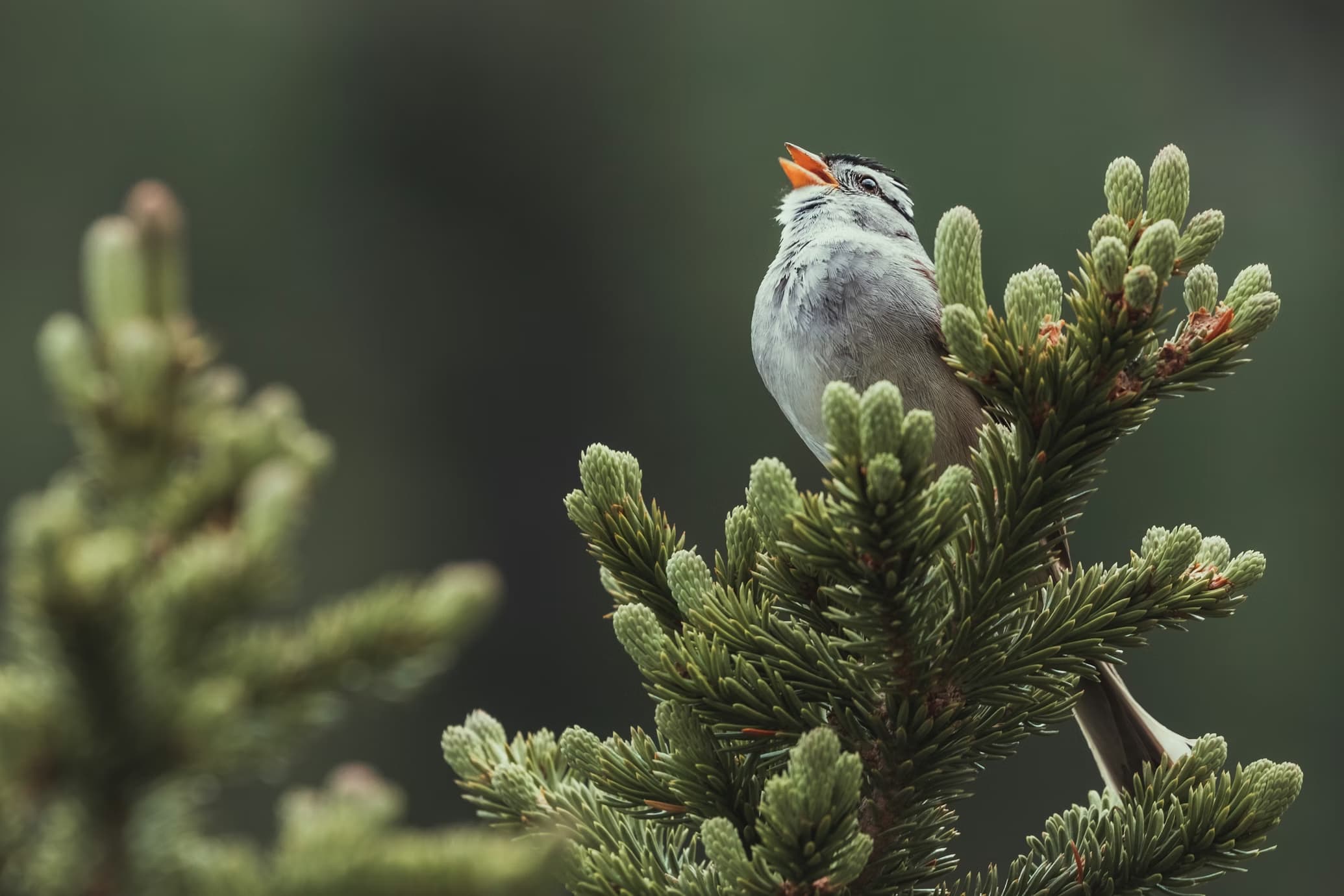
Once you know what makes a mnemonic fit, one variable is left, and it is you. Mnemonics are personal and regional, and for a lot of birds there simply is no single "right" one. The classic proof is the White-throated Sparrow, whose pure, wavering, faintly wistful whistle has split birders for a century. Some hear "Oh sweet Canada Canada Canada"; others swear it is "Old Sam Peabody Peabody Peabody." Same whistles, same bird. You just pick the phrasing that sticks for you. It is a winter and migration bird across most of the country, so this is a voice you will catch on cold-month walks nearly everywhere in the US, while it spends July up on its northern breeding grounds.

Here is the wild part that makes this bird the perfect permission slip. These sparrows are actually changing their tune. The old three-note version ("Canada Canada Canada") is being replaced by a two-note doublet ("Canada Canada"), a new phrasing that has swept west-to-east across the continent over the last couple of decades like a hit song going viral in sparrow-world. Even the birds cannot agree on the right mnemonic anymore. So if you want to invent your own, you are in genuinely excellent company.
A few birds skip the debate and just tell you their names. The Eastern Phoebe buzzes a raspy "FEE-bee," and that is its name. Careful with a look-alike trap, though: the Black-capped Chickadee also whistles a sweet, clear "fee-bee," but that one is it flirting, not naming itself (its actual name-call is the fuzzy "chick-a-dee-dee"). The Phoebe's version is raspier, like it needs to clear its throat first. A couple of others wear their names too: the Eastern Wood-Pewee sighs a lazy "pee-a-wee," and the Killdeer shrieks its own name across ballfields and gravel lots, often at two in the morning, to no one's delight. (Curious why a killdeer screams kill-deer in the first place? We dug into it.)
You have permission now, so here is how to build a mnemonic for a bird nobody has handed you a phrase for. Three steps, and they map straight onto everything above.
Step 1: catch the rhythm first, before any words. Count the notes. Clap the pattern back with your hand on your leg. Is it three even beats like the titmouse, or a rising shout like the Ovenbird? Get the shape before you reach for language: the shape is what your phrase has to fit.
Step 2: fit words that scan. Now lay a phrase over the beat you just clapped. Nonsense is completely fine ("pizza pizza pizza" will do for anything with three even notes); personal is even better ("where's my COFF-ee"), because the weirder and more yours the phrase is, the harder it sticks. That is the language-durability trick from earlier, working in your favor. The bird does not care what you call it. Only your memory does.
Step 3: say it out loud the instant you hear the bird. Not later, not in your head. Out loud, in the moment. Speaking the phrase laminates the sound to the words while the song is still in the air. In the field the whole thing becomes a quick loop: hear it, name the rhythm, say your phrase, then look up to confirm who sang it. Four beats, a few seconds, and another voice is filed for good.
One phrase becomes two, two become a repertoire, and a spring morning stops being noise and turns into a conversation you can follow. That is exactly the engine behind our gentle two-week method for learning bird songs by ear, and if you would rather front-load the practice, the seven-day plan for learning bird calls fast runs the same loop on a tighter schedule. Wings & Whistles is where you drill the words until the voices stay with you, one phrase at a time.
A bird song mnemonic is a short phrase that matches the rhythm of a bird's song, like the Barred Owl's "who cooks for you." It helps because your memory holds onto language far more reliably than it holds abstract pitch. Pinning words to a song gives the sound a handle you can recall on command and bundles a blur of notes into one memorable unit.
The Barred Owl. Its classic hooting phrase runs roughly "who-cooks-for-you, who-cooks-for-you-all," with a distinctive downward drawl on the final note. It is a year-round resident of eastern and Pacific-Northwest forests and calls in daylight as readily as after dark, which is why so many people first learn it on an evening walk.
The Ovenbird, a warbler that walks the forest floor rather than the treetops. Its ringing "teacher, teacher, TEACHER" grows steadily louder over the first few repetitions, typically eight to thirteen phrases building to a shout. It is a spring and early-summer song across eastern woodlands, so you are listening for it from May into June, not year-round.
The Eastern Towhee. Its song is often written "drink-your-TEA," with the final note buzzing off into a musical trill. You will usually hear it before you see it, because towhees forage by noisily kicking through leaf litter in brushy edges, thickets, and hedgerows.
It only sounds that way. Birds are not speaking English; a mnemonic simply maps their notes onto words that share the same rhythm and stress, so your brain hears a phrase. A handful of species do seem to say their own names, like the Eastern Phoebe's raspy "fee-bee" and the Killdeer's shrill "kill-deer," but that is a coincidence of sound, not actual speech.
Catch the rhythm first: count the notes and clap the pattern back before you reach for any words. Then fit a phrase that scans to that beat, nonsense or personal, since the odder and more yours it is, the better it sticks. Finally, say it out loud the moment you hear the bird, which laminates the sound to the words while the song is still in the air.
The Tufted Titmouse. Its clear, whistled "peter-peter-peter" lands every "peter" on the same even stress, which is exactly what makes the mnemonic stick. It is a year-round backyard resident across the eastern United States that sings for much of the year, so it is one of the easiest of these songs to go confirm at your own feeder.
Open any bird for its recordings, what to listen for, and the birds it gets mistaken for.
Start learning birds by ear. Turn these phrases into lessons that stay with you. Download Wings & Whistles Google Play
You have the mnemonics. Here is the ten-minute-a-day rhythm that turns seven of them into named neighbors in two weeks.

The Barred Owl asking "who cooks for you" is one of them. Meet the rest of the after-dark chorus and learn each voice by ear.