Sound Guide
6 Birds That Sound Like Squeaky Toys (Meet the Culprits)
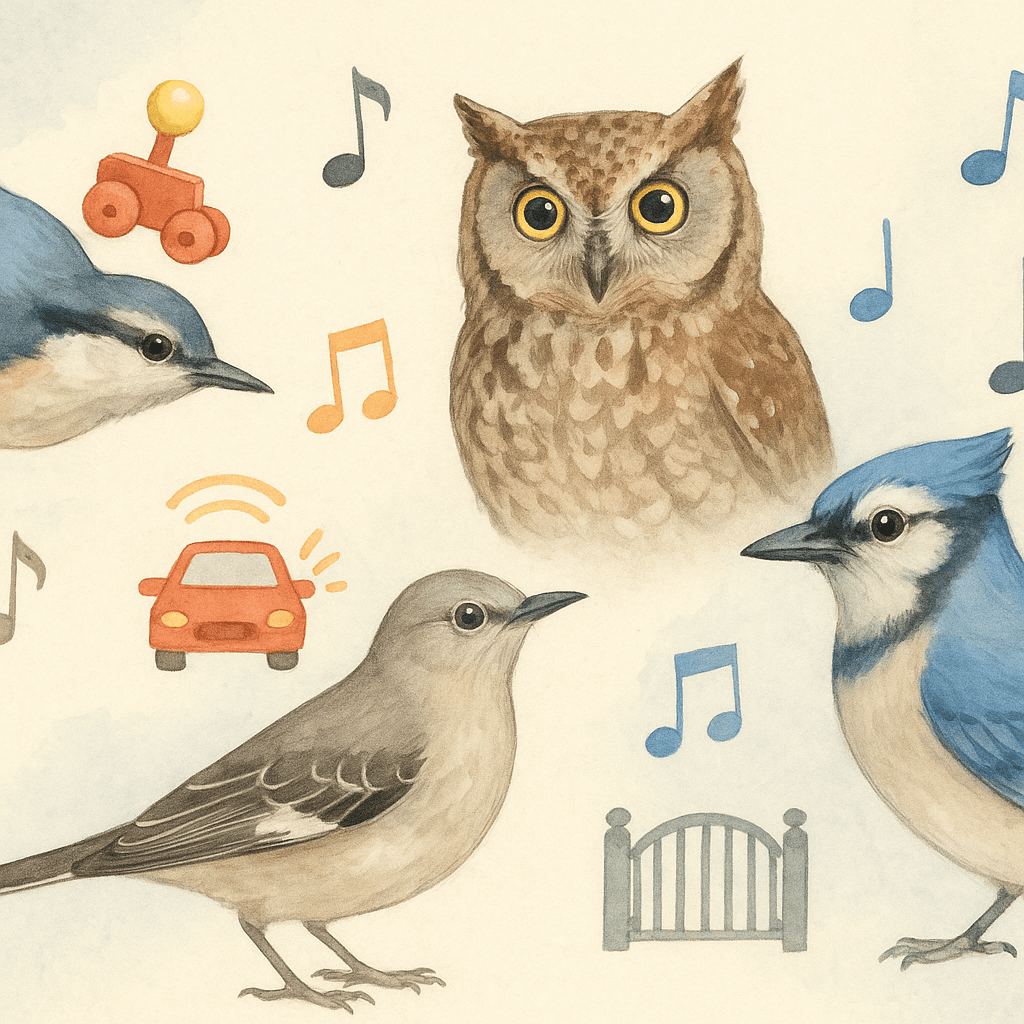
Rubbery, bouncy, and impossible to ignore. Meet the birds whose calls sound like a dog toy in the next room.
Read Article →

Except nobody is out there. The yard is empty, the gate is shut, and the sound is coming from about thirty feet up a maple. Thin, rhythmic, a little rusty: wee-see, wee-see, wee-see, wee-see. It has the exact cadence of a wheel that needs oil and the exact patience of something that has all day.
That is a bird. Almost certainly a warbler. And in eastern North America between April and July, it is usually a Black-and-white Warbler, a striped little bird that creeps along tree trunks like it took a wrong turn on the way to being a nuthatch.
Here are the six birds behind the squeaky-wheel sound, including the one that squeaks in the dark (it is not the warbler, and most articles get this wrong) and the one that does it in British gardens.
Hear all six side by side and learn them for good. Get the app free →
If you want to stop reading here and go be right in front of your family: it is a Black-and-white Warbler. That is the answer to the question far more often than any other bird, and once you have heard it named, you will never un-hear it.
Why does a four-inch songbird sound like neglected hardware? Three reasons, and they stack.
Your brain, being an excellent pattern-matcher and a terrible birder, files all of that under "wheel" before you have finished turning your head. It is a compliment to the bird, really.
Before we go deeper, triage. The word your brain reached for tells you almost everything:
The Black-and-white Warbler is a bird that looks like a tiny zebra and behaves like a bird that has never met another warbler. While the rest of its family flits around the outer twigs eating caterpillars in good light, this one hitches headfirst down tree trunks and along big limbs, picking bark like a nuthatch, working the least glamorous real estate in the forest.
And the whole time, it squeaks.
The song is a thin, high, two-note phrase (wee-see, wee-see, wee-see) repeated six, seven, eight times, at a steady unhurried pace, with the second note dropping slightly below the first. Field guides describe it as sounding like a squeaky wheel because it sounds exactly like a squeaky wheel. There is no metaphor to unpack here. A cart is being pushed across a wooden floor, forever, in the canopy.
Audio fingerprint: Wispy and dry, never rich. Perfectly even spacing. Quiet enough that you might miss it near a road, insistent enough that you cannot un-hear it once you are listening. Think of a wheelbarrow going slowly away from you.

Deciduous and mixed woods across the East, plus any park with mature trees and a little bit of dignity. They arrive early (often the first warbler back in spring, weeks ahead of the flashier ones), and males sing through the breeding season, which is why this search spikes every May and keeps humming right through July. (If you are hearing new voices arrive in waves, that is not your imagination either: see our guide to the bird songs that show up in May.)
Best clue: the sound comes from a trunk or a heavy limb, not the leafy outer edges. Look at the bark, not the tips of the branches. It is a small, striped, upside-down bird, and it is the only warbler that will ever behave that way in front of you.
How to rule it out: if the squeak is loud, harsh, or has any grit to it, you are not on a Black-and-white. This bird is a paper cut, not a power tool.
Warblers are, as a family, deeply committed to the high thin end of the spectrum. Two others land close enough to "squeaky wheel" that people mix them up with the Black-and-white constantly. Here is how to keep them straight.
The Black-throated Green Warbler sings like it is doing you a favor. Its everyday territorial song is a lazy, buzzy zoo-zee-zoo-zoo-zee (the one older birders learn as trees, trees, murmuring trees), and it has a second, more emphatic version, zee-zee-zee-zoo-zee, that it saves for arguments and courtship.
Honesty check: this is more buzzy than squeaky. It has a wheeze in it, a slight electric fuzz, where the Black-and-white is clean and dry. But it lives in the same pitch neighborhood and the same slow rhythm, so if the squeaky wheel you heard sounded like it needed a nap, this is your bird. Look for it in conifers, hemlocks especially, where it sings from mid-height and refuses to hurry.
Audio fingerprint: Drowsy, buzzy, drawn out. A wheel turning through wet sand.

The American Redstart is the one that makes people give up. Its song is a short series of high, thin, squeaky notes (so far, so Black-and-white), but the last note usually snaps downward, sharp and emphatic, like a very small, very polite sneeze. See-see-see-see-SEEoo.
The complication is that redstarts do not commit to one phrasing. A single male will rotate through several song types, sometimes ending flat, sometimes ending with that hard down-slur, sometimes changing versions between songs just to keep you humble. Meanwhile he is fanning that orange-and-black tail like a magician forcing a card. He is a busy, showy little bird, and his song is a fidget.
Audio fingerprint: High, thin, and punctuated. If the squeak had an ending (a flourish, a flick, a downturn), think Redstart.

"Squeaky" is not one sound, and the object your brain picked is doing real diagnostic work. A wheel is thin, rhythmic, and repetitive. A gate is bigger, slower, and has some groan behind it. A toy is rubbery, bouncy, and sounds like it wants something. Different objects, different birds.
If the squeak had weight to it, like a heavy hinge or the handle of an old water pump being worked up and down, you have met a Blue Jay. Jays have an absurd soundboard (screams, whistles, a startlingly good Red-shouldered Hawk impression), and tucked in there is a rusty, ratcheting call that birders literally call the "pump-handle." It is squeaky the way a barn door is squeaky: loud, unhurried, and clearly attached to something large.
That call belongs to a different search, so we gave it its own home: read the birds that sound like a squeaky door or rusty gate, where the jay gets a full hearing alongside Pine Siskin and the genuinely hinge-like Rusty Blackbird.
And if the squeak sounded rubbery (cheerful, bouncy, a rubber duck squeezed by someone with excellent time management), that is a Brown-headed Nuthatch, the pine-loving squeaker of the Southeast. They travel in chatty little gangs and they do not stop. A wheel needs oil; a nuthatch needs an audience.

Play that clip, then scroll back up and play the Black-and-white Warbler again. Toy versus wheel. Once you have heard them back to back, the distinction is permanent, and the whole squeaky-toy bird lineup opens up behind it.
The full decision tree, in the order your ear actually runs it:
Wheel, gate, or toy? Train your ear on all three in a few minutes a day. Download Wings & Whistles Google Play
This is where a lot of articles quietly lie to you, so let us be precise about what "at night" means. Look at the sky.
The dawn chorus does not wait for sunrise. It starts in the dark, a full hour or more before the sun clears the horizon, which means a thin, rhythmic wee-see wee-see at 4:30 a.m. in June is very likely a Black-and-white Warbler warming up while you were hoping to sleep. That is not a night bird. That is the day shift clocking in early. (Some of the best listening of the entire year happens in exactly that half-hour; the dawn chorus is worth setting an alarm for, ideally on purpose.)
At 2 a.m., your squeaky-wheel warbler is asleep. Warblers do move at night on migration, but the only sound they make up there is a short, thin seep: a single high tick passing overhead, nothing like a wheel. A steady, mechanical squeak coming out of real darkness is almost always an Eastern Screech-Owl, a bird the size of a coffee mug that has been living in your neighbourhood the entire time without telling you.
The screech-owl keeps two voices, and they come from the same small owl, sometimes minutes apart. For the squeaky-wheel question, one of them is the answer and the other is the plot twist.

And here is the whinny, so you can rule it in or out without waiting for the owl to perform on demand:
Play the trill twice. The first time you will hear an owl; the second time you will hear the machine your brain thought it was, and the two will finally sit on top of each other. Once the trill is locked in, the whinny slots in behind it for free: same bird, different mood. For the rest of the night shift (the yelps, the wails, the genuinely alarming screams), we have a whole field guide to the weird bird sounds you hear after dark.
None of the warblers above live in Britain, so if you are hearing a squeaky wheel from a hedge in Hampshire, the whole cast changes. Your bird is almost certainly a Great Tit.
Its song is a bright, ringing, two-note see-saw (tea-cher, tea-cher, tea-cher) so evenly pitched and so relentlessly repeated that it lands in the same mental bucket as a squeaky wheel, a bicycle pump, or a rusty swing. It is louder and cleaner than the American warblers, more of a proper ringing note than a wispy one, but the rhythm is identical: up, down, up, down, until the neighbourhood agrees.
Audio fingerprint: Two notes, endlessly alternating, with a metallic ring. Someone pumping up a bicycle tyre in a very organised way.

Great Tits are also famous for having an enormous repertoire, which means the individual in your garden may work through several variations on the see-saw and leave you convinced there are four birds out there. There is one. He is just showing off. For the fuller British lineup (Blue Tit, Dunnock, Robin and friends), head to our UK squeaky-bird guide.
Here is the thing about the squeaky-wheel bird: you are going to hear it again tomorrow. And the day after. Warblers sing on a schedule, and yours has picked your street. So you can look it up every May for the rest of your life, or you can spend about ten minutes learning it and be done forever.
The gentlest way in is a three-listen method. It takes less time than the average search-and-scroll spiral.
That is exactly the loop Wings & Whistles is built around: short lessons that pair the sound with the name, then send you outside to catch it for real. Our full walkthroughs on learning bird songs by ear and how to identify bird sounds go deeper if you want the method without the app.
And if the squeaky wheel turns out to be a clean, human-sounding whistle instead, you are in a different neighbourhood entirely. Go meet the birds that sound like someone whistling at you.
In eastern North America, the Black-and-white Warbler is the classic answer. Its song is a thin, high, endlessly repeated wee-see wee-see wee-see that sounds like a cart wheel that needs oil. Black-throated Green Warbler (buzzier) and American Redstart (ends with a sharp down-slur) are the two most common runners-up.
Check the sky first. A squeak in the grey hour before sunrise is still your daytime warbler: the dawn chorus begins well before the sun is up. A steady, rhythmic squeak in true darkness is far more likely an Eastern Screech-Owl, whose long, even, hollow trill sits on one pitch and reads to most people as a small motor. (Its other night sound, a descending whinny, is the one that gets called a squeaky swing.) Black-and-white Warblers do not sing their squeaky-wheel song at night; migrating overhead in the dark, they give only a thin seep flight call.
The Great Tit. Its ringing, two-note tea-cher tea-cher song has the exact see-saw rhythm of a squeaky wheel or a bicycle pump, and it is one of the most common garden birds in Britain. Blue Tit and Dunnock are the next places to look if the sound was busier or scratchier.
Usually, yes, if you heard it in daylight or at dawn, in the eastern US or Canada, between April and August. It is the single most-cited squeaky-wheel bird in North America, and the trunk-creeping habit gives it away: look at the bark of big limbs, not the leafy twigs where other warblers hang out.
Texture and rhythm. A squeaky wheel is thin, dry, and mechanically even: the same two notes repeated without variation, which is the Black-and-white Warbler. A squeaky toy is rubbery and bouncy, with more life in it, which in the Southeast usually means a Brown-headed Nuthatch. If the sound is bigger and creakier than either, you are probably hearing a Blue Jay working its rusty pump-handle call.
Pitch, rhythm, and repetition. Very high, thin notes lose their musical warmth to human ears and start to register as friction; a two-part up-down phrase has the shape of something rotating; and six or eight identical repeats hit the one pattern our brains reserve almost exclusively for machines. The bird is not imitating anything. Your pattern-matching is just doing its best.
The same bird that sounds like a squeaky wheel: the Black-and-white Warbler. A swing and a wheel make the same sound to human ears, a thin, high, two-part note repeated at an even tempo. If the squeak is rubbery and bouncy rather than thin and dry, you have a Brown-headed Nuthatch instead, which is a toy rather than a swing.
Open any bird for its recordings, what to listen for, and the birds it gets mistaken for.
Start learning birds by ear Download Wings & Whistles Google Play
Rubbery, bouncy, and impossible to ignore. Meet the birds whose calls sound like a dog toy in the next room.
Bigger, creakier, and hinged. The Blue Jay pump-handle call, the Rusty Blackbird, and three more suspects.