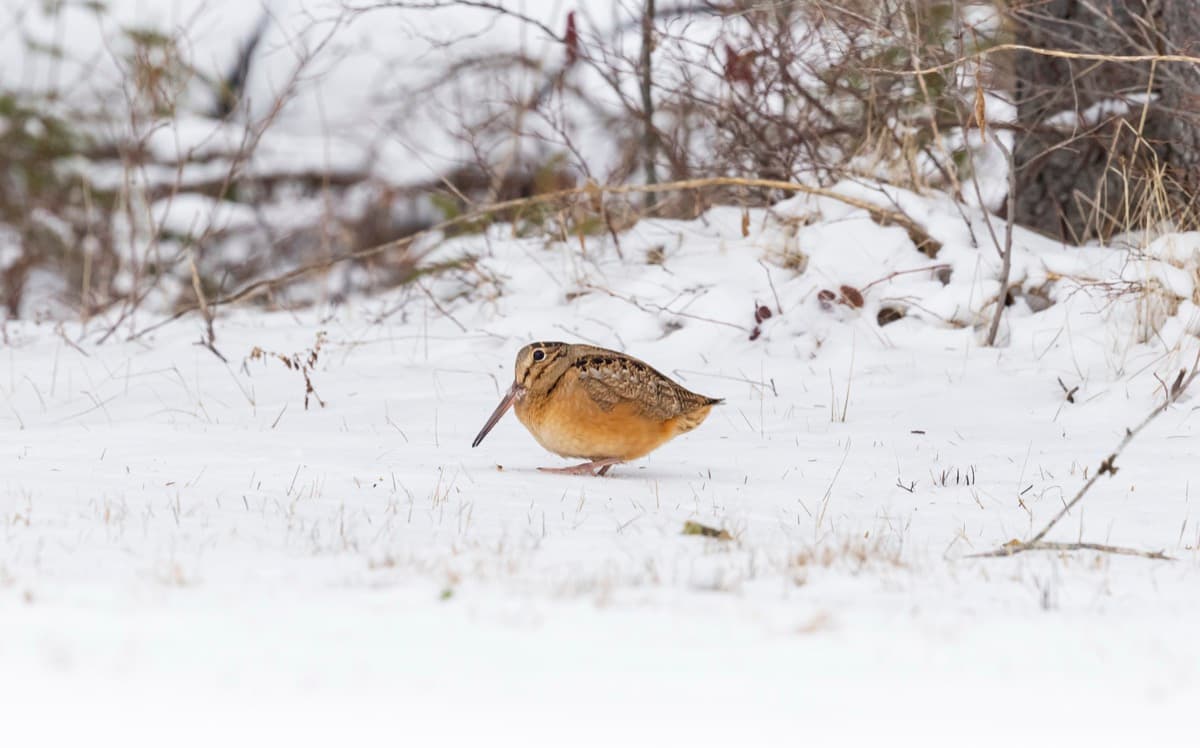
Behavior
Why Do Woodcocks Dance? The Viral Bird's Weirdest Secret, Explained
The peent is only the opening act. Here is the twittering sky dance that follows it, and why the woodcock does it.
Read Article →
You looked up, and that was the right instinct, because frogs do not fly. A surprising number of "frog" sounds turn out to be birds, and the clue is usually something you noticed without meaning to. This post turns that hunch into three listening cues, picked up one at a time as we walk through the year, so you can name the next croak from the porch instead of lying awake over it.
In North America, a buzzy peent from an open field at dusk in late winter or spring is an American Woodcock. A deep croak from overhead, in any month, is a Common Raven. A flat quok over water after dark is a Black-crowned Night-Heron. A frog sound mixed into a run of other voices is a Northern Mockingbird.

Start here: a woodcock's buzzy peents from the ground, then the twittering of his display flight. This is the frog impostor of late winter and early spring, and it is the one most worth learning before the season starts.
A croak with no pond in sight? Record it in Wings & Whistles and see what it matches. Get the app free →
One fact does most of the work in this post: a calling frog is almost always sitting in one wet place, low down, and it stays there. Frogs call from the water, from the mud at the edge of it, or from the plants right around it. Tree frogs climb a little higher, but they keep close to the water and they stay put.
A bird has no such rule. It can call from the sky, from a rooftop, from a telephone wire, or from the middle of a field that has not held a puddle in weeks. So before you think about what the sound was like, ask where it came from. That is cue one: position. Is the sound near water, near the ground, and staying in one spot?
Your October croak fails all three tests. It came from above, over a yard with no pond, and it was moving. That is a bird, and we will name it shortly. But the first frog impostor of the year is sneakier, because it calls from the ground. To catch it, we need to go back to the tail end of winter.
Picture an old field at the edge of some young woods, twenty minutes after sunset, early in the year. The ground is cold and the light is nearly gone. From somewhere in the grass comes a short, buzzy peent. A pause of a few seconds. Then peent again, from the same spot. It sounds like a game-show buzzer with a head cold, or like the field itself has developed a small electrical fault.
That is a male American Woodcock, and because he calls from the ground, plenty of people file the sound under frog or insect and go back inside. After a run of peents he goes quiet, climbs into the sky in a twittering display flight, then drops back down and starts peenting again. (The flight is its own story, and a strange one; we told it in Why Do Woodcocks Dance? Here we only need the peent.)
When to listen: the display starts as early as December down South and works its way north through late winter and spring, running into May in the northern part of the range. A single male can keep it up for as long as four months. The show happens at dusk and again in the dim light before dawn, over open fields, clearings, and old pastures across the East.
Now run cue one on him, because he is the reason the cue needs care. The sound is low, at ground level, and it stays put, which is all very frog-like. But look at the setting. A frog chorus needs a pond, and a woodcock needs only open ground: a hayfield, a power-line clearing, the scruffy lot behind the soccer fields. A lone "frog" calling every few seconds from the middle of a field with no water in sight, at dusk, in March? That is a woodcock. Position is not only "how high"; it is also "near what."
Then, a few months later, the same syllable moves upstairs. On summer evenings a nasal peent comes from above you, often right over town: over a parking lot, a ballfield, a row of rooftops. That is a Common Nighthawk, a long-winged bird hunting insects in the air. Listen long enough and you may also hear a sudden booming whoosh as a male dives and pulls out, the air rushing through his wing feathers. Nighthawks arrive in late spring and head for South America from late summer into early fall, so a peent from the sky in July is never a woodcock.

The nighthawk clip: nasal peents in flight, plus the booming wing sound of a diving male.
Same syllable, opposite positions. The woodcock peents from the ground in late winter; the nighthawk peents from the sky in summer. Neither one is sitting in water, and that is cue one doing its job. Keep looking up, though, because the next suspect hardly ever comes down.
Back to that October evening. The crrruk overhead, deep and hollow and rolling, like a frog calling down a drainpipe, is a Common Raven. Birders do not even reach for a comparison with this one: the raven's call is simply called a croak. It is often given by a bird flying high or soaring, and it carries a long way, which is why it can seem to drop out of an empty sky.

The raven's croak: hollow, throaty, and far lower than a crow's caw.
The bird you are more likely to confuse it with is not a frog at all but the American Crow. A crow's caw is higher and flatter, like a complaint. A raven's croak is lower and rounder, like the same complaint made from inside a barrel. If you get a look, the raven is the bigger bird with the wedge-shaped tail, and it likes to show off: rolls, tumbles, and the occasional stretch of flying upside down, apparently for the fun of it.
Ravens stay put all year, so this is the suspect for any month, including the ones when no frog in its right mind is calling. They live across the West, through Canada and the northern woods, and down the Appalachians, and they have been turning up in more of the East in recent decades. More recordings are on the Common Raven page.
Cue one settles the raven fast: the croak came from above, and it traveled across the sky. Frogs can do neither. But cue one has a weak spot, and the next bird finds it: a croak from overhead and right above the water, where the frogs live.
Want the peent and the croak in your ear before spring? Drill them by sound now, before the first peent of the season. Download Wings & Whistles Google Play
Stand by a lake, a slow river, or a city park pond on a summer night. Out of the dark above you comes a single flat quok. Then nothing. Then another quok, a little farther along. It sounds like a frog that took one deep breath and said exactly one word.
That is a Black-crowned Night-Heron, a stocky heron that spends the day hunched in a tree like a retiree on a park bench, then heads out at dusk to hunt through the night. (The name is not a figure of speech.) The call is usually written quok or woc, and it is often given in flight, so what you are hearing is a bird commuting between its roost and the water's edge. In the North, night-herons are mostly a spring-to-fall sound; in the southern United States they stay through the winter. The Black-crowned Night-Heron page has more on where to find them.

Flat quok calls from a night-heron flying over.
Here cue one wobbles. The sound is above you, but it is also right over the water, and in the dark it is hard to judge how high "above" really is. So add cue two: number. Frogs that are calling usually do it in a crowd: lots of matching voices from the same patch of pond, overlapping, steady, going for hours. A night-heron gives you one voice, one note at a time, with long gaps, and each note lands somewhere slightly different because the bird is moving. One voice that travels is a bird. A chorus that stays put is frogs.
If the croak is bigger, hoarser, and grumpier, and it came from something enormous you just startled off the bank, that is the night-heron's tall cousin, the Great Blue Heron, which lets out a few hoarse croaks when it is alarmed.
Position and number will sort out most of the birds that pass for frogs. The last suspect beats both of them, and it does it on purpose.
Late spring, close to midnight. A frog is calling from the top of your neighbor's chimney. Cue one says bird, obviously, because frogs do not climb chimneys. But move the same singer into a hedge beside a garden pond and cue one shrugs. Cue two is no help either: this is one voice, and a frog calling alone is one voice too.
So listen a little longer. After a few repeats, the frog turns into a cardinal. Then a car alarm. Then something like a squeaky gate. That is a Northern Mockingbird, and it imitates frogs as readily as it imitates other birds and the hardware of your street. A mockingbird repeats each sound several times and then switches, which hands you cue three: variety. A frog makes one sound all night. A mockingbird runs through a playlist.

A mockingbird medley. There is no frog in this particular recording, so listen for the pattern instead: each sound a few times, then a switch. That pattern is what gives the bird away, whatever it happens to be copying that night.
Mockingbirds also sing after dark in spring and summer, mostly unmated males with something to prove, which is how a frog ends up performing from a chimney at 1 AM. Its cousin the catbird pulls the same frog trick. A Gray Catbird sings each phrase once instead of repeating it, so its frog goes by fast, tucked into a hurried jumble from inside a shrub. And if "car alarm in the tree" was your other mystery this year, it is the same performer doing a different impression: see What Bird Sounds Like a Car Alarm?
One more for the "frog in an odd place" file. If the croak comes from a duck on a wooded pond in winter, it is probably a drake Hooded Merganser courting, crest fanned out and head thrown back. Yes, a duck that sounds like a frog. Birding is like that.
Put the three together and you have a check you can run on any croak, peep, or quok in the dark:
Then check the calendar. Frogs are cold-blooded, and most of them call on mild, damp nights from spring into summer. The earliest ones, like wood frogs and spring peepers, start up around ice-out, sometimes on nights barely above freezing, so cold alone does not rule a frog out. But a croak over a pond that is frozen solid is a bird, and a croak from a clear winter sky is almost certainly a raven.
Bird-or-bug works the same way with its own three cues, and the insect half of the night shift is in Bird or Bug? How to Tell Insect Sounds From Bird Songs by Ear. For more voices of the dark, try What Bird Sings at Night? And if your mystery is a pumping, gulping sound from a marsh, that is the bittern, and it gets the full treatment in 11 Weird Bird Sounds.
The quickest way to make the three cues automatic is to hear the birds before you need them. In Wings & Whistles, the woodcock lives in the Night Shift: Who's Out There? lesson, the raven in Sky 'Kee' Clinic, the mockingbird in The Mimic Trap, and the bittern in Marsh Mystery Voices. A few minutes a day, and by the time the woodcocks start up this winter, the peent will sound like a name instead of a noise. (The method behind that is in How to Learn Bird Songs by Ear.)
And if it does turn out to be a frog? Good. Now you know that too.
After dark, the likeliest bird is a Black-crowned Night-Heron, which gives a single flat quok as it flies over lakes, rivers, and city ponds. On spring nights a Northern Mockingbird can slip frog imitations into its song, and at dusk in late winter and spring a buzzy peent from an open field is an American Woodcock.
The Common Raven's call is known as a croak: a deep, hollow, rolling crrruk, usually from a bird flying overhead, in any month of the year. It is much lower and more resonant than an American Crow's caw. Near water after dark, the Black-crowned Night-Heron's flat quok is the other common croaker.
Ask three questions. Where is it, and is it moving? Frogs call from one wet spot near the ground, while birds call from the sky, rooftops, and open fields. Is it one voice or a chorus? Calling frogs usually gather in crowds of matching voices. Is it one sound all night, or a playlist? A frog repeats one call; a mockingbird keeps switching.
Yes. Northern Mockingbirds imitate frogs along with other birds and mechanical noises. The giveaway is the pattern: a mockingbird repeats each sound several times and then switches to something else, while a real frog keeps making the same call. Its close relative the Gray Catbird slips frog impressions in too.
In late winter and spring, a buzzy peent repeated from the ground in an open field at dusk or dawn is a male American Woodcock, which then climbs into a twittering display flight. In summer, a similar nasal peent from overhead, often above towns, is a Common Nighthawk.
Yes. The drake Hooded Merganser gives a low, frog-like croak during his courtship display, when he fans his crest and throws his head back. Listen for it on wooded ponds and quiet rivers from late fall into early spring, when pairs are forming.
Open any bird for its recordings, what to listen for, and the birds it gets mistaken for.
Bird or frog, by ear. Learn the woodcock in Night Shift and the mockingbird in The Mimic Trap this winter, then find them in the wild come spring. Download Wings & Whistles Google Play
The peent is only the opening act. Here is the twittering sky dance that follows it, and why the woodcock does it.
The companion lesson: three cues that separate a bird's trill from a cricket's, and a cheat sheet for the next mystery buzz.