Night Sounds
Weird Bird Sounds at Night: Identify Strange Calls
The 2 AM edition. Match the strange call you heard to the most likely species using sound clues, habitat, and time of year.
Read Article →
A foghorn in the marsh. A laugh across the lake. A rubber duck in a pine tree.
Some birds do not sing so much as malfunction. They pump, they laugh, they buzz, they boom, they squeak like a dog toy under a car tire. And the first time you hear one, your brain does the sensible thing and files it under "not a bird," which is exactly why you are here, typing "weird bird sounds" into a search bar and hoping for an answer that is not a ghost.
Good news: it is almost never a ghost. Here are 11 of the strangest sounds in North America, each with real audio you can play right now, and each with a hook you can actually hold onto. Because the weird stops being unsettling the moment it has a name.
Every sound below is a lesson in Wings & Whistles: hear it, name it, keep it. Get the app free →
You have a mental template for "bird." It is roughly: small, high-pitched, chirpy, a little melodic, mildly cheerful about the whole thing. Robins fit it. Cardinals fit it. So when a sound arrives that is low, or mechanical, or seven seconds long with no repeating pattern, your brain checks the template, finds no match, and reaches for the next best explanation: plumbing, a machine, a large mammal, an intruder, a ghost.
The birds are not being weird at you. They are solving physics problems. Low frequencies bend around cattails and travel farther through dense vegetation, which is why a marsh bird sounds like a foghorn instead of a flute. Pure, sharp tones cut through leaf clutter, which is why some forest calls sound electronic. And a bird trying to be heard by a female half a mile away has every reason to sound absolutely unhinged doing it.
Once you have listened to enough of them, the weird sorts itself into four flavors. That is the whole trick of this post: not memorizing 11 random noises, but learning four categories so the next weird thing you hear lands somewhere:
One more thing before we start: not every "bird sound" comes out of a bird's mouth. Two of the birds below make their signature noise with their feathers. (We will get there. It is the best part.)
The sound: A deep, gulping, three-beat onk-a-CHUNK... onk-a-CHUNK, coming from inside a wall of reeds. It has a wet quality, like the marsh is trying to swallow and having a hard time of it. Old-timers called this bird the "thunder-pumper" and the "stake-driver," which tells you everything: nobody who heard it thought bird first either.

Why it sounds like that: The bittern gulps air and inflates its esophagus like a bagpipe, then forces it out in that pumping rhythm. The result is a low, resonant boom that rolls straight through dense cattails without getting eaten by the vegetation. A marsh is a terrible place to be heard, and this is the workaround.
Where and when: Freshwater marshes across much of North America, mostly spring into early summer. And here is the cruel joke: you will almost never see the thing. A bittern freezes with its bill pointed straight up and its striped neck lined up with the reeds, and it becomes, convincingly, a reed. You will hear a foghorn from a patch of cattails ten feet away and stare directly at an empty marsh.
The sound: A rolling, rattling, bugled garrrooo, like someone playing a rusty trumpet through a cardboard tube, with a drumroll baked into the middle of the note. It carries. A mile, easily. People hear cranes long before they find the specks in the sky, then spend a minute genuinely unsure whether the sound came from above them or from a nearby farm.

Why it sounds like that: A crane's windpipe is absurdly long and coils into its breastbone like a French horn. That coiled tube adds the rattle and the low harmonics. The bird is, functionally, a brass instrument with legs. It is also the reason the call sounds ancient: cranes have been doing roughly this for millions of years, and it shows.
Where and when: Wetlands, prairies, and farm fields, most dramatically during migration, when tens of thousands stack up at places like the Platte River in Nebraska. If you hear a rusty bugle drifting down from a clear sky in fall or spring, look up. Way up.
If a sound is low, rhythmic, and repeating on a beat, and you are anywhere near water, stop looking for a small bird in a tree. Pumps come from big birds standing in wet places, and they are almost always closer than they sound.
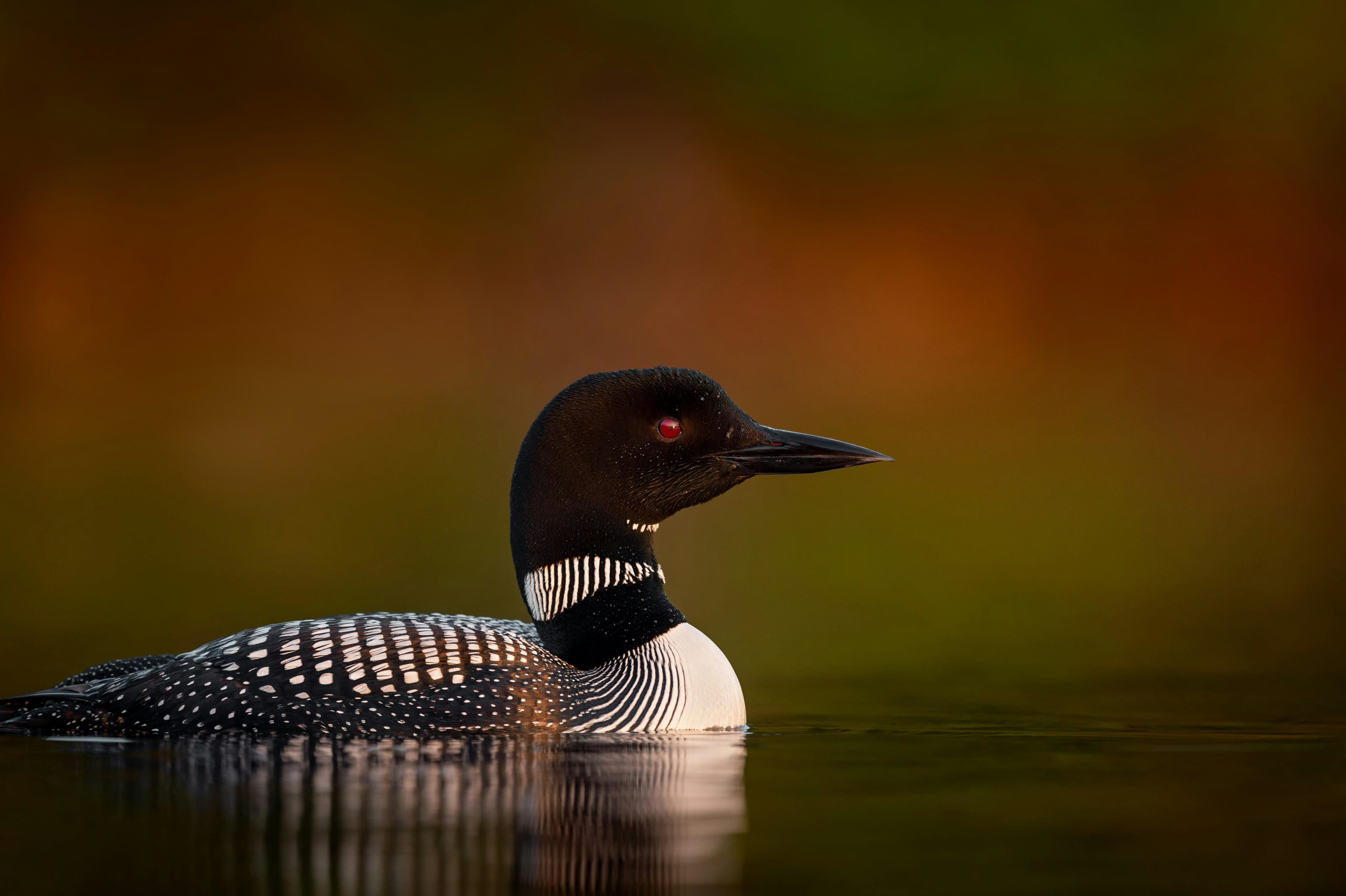
Loons have a whole vocabulary, and the two that matter for "what was that" purposes are the tremolo and the wail. Birders keep these separate, and once you know why, you will too.
The tremolo is the wavering, quavering laugh: a shaky, slightly hysterical giggle across the water. It is the loon's agitation call. An eagle overhead, a canoe too close, a neighbor loon getting ideas. If a loon laughs at you, you are being told off. That is the clip below.

The wail is the other one: the long, mournful, rising-and-falling howl that Hollywood drops into every foggy scene it can find. That is the call that travels. It is how loons locate each other across a dark lake, and it is the sound people mean when they say a loon is "haunting." Wolf-adjacent, but sadder and made of water. (Sound editors love it so much they have used it in deserts and on alien planets, where loons are famously scarce.) Here it is:
Keep the pair straight like this: the laugh means it is upset, the howl means it is looking for someone. Two very different pieces of information from one bird on one lake.
The sound: Two of them, and neither is a screech. The trill is a single even pitch, a long hollow purr that goes on and on, like a ghost idling. It is the one people most often blame on a tree frog or a large insect before someone tells them it was an owl the whole time. (Mixing up bugs and birds is common enough in summer that we wrote a whole ear-guide on how to tell insect sounds from bird songs.)

The whinny is the other voice: a descending, quavering tremble, like a horse the size of a soda can, unimpressed with you, from a tree you cannot see into. Play them back to back and the difference stops being subtle.
Why it messes with you: Screech-Owls are eight inches tall and live in suburbs, so this sound arrives from a normal backyard oak at a volume that suggests something much bigger and much less local. The trill is also weirdly hard to place. It seems to come from everywhere and nowhere, which is a very effective trick for a bird that does not want to be found.
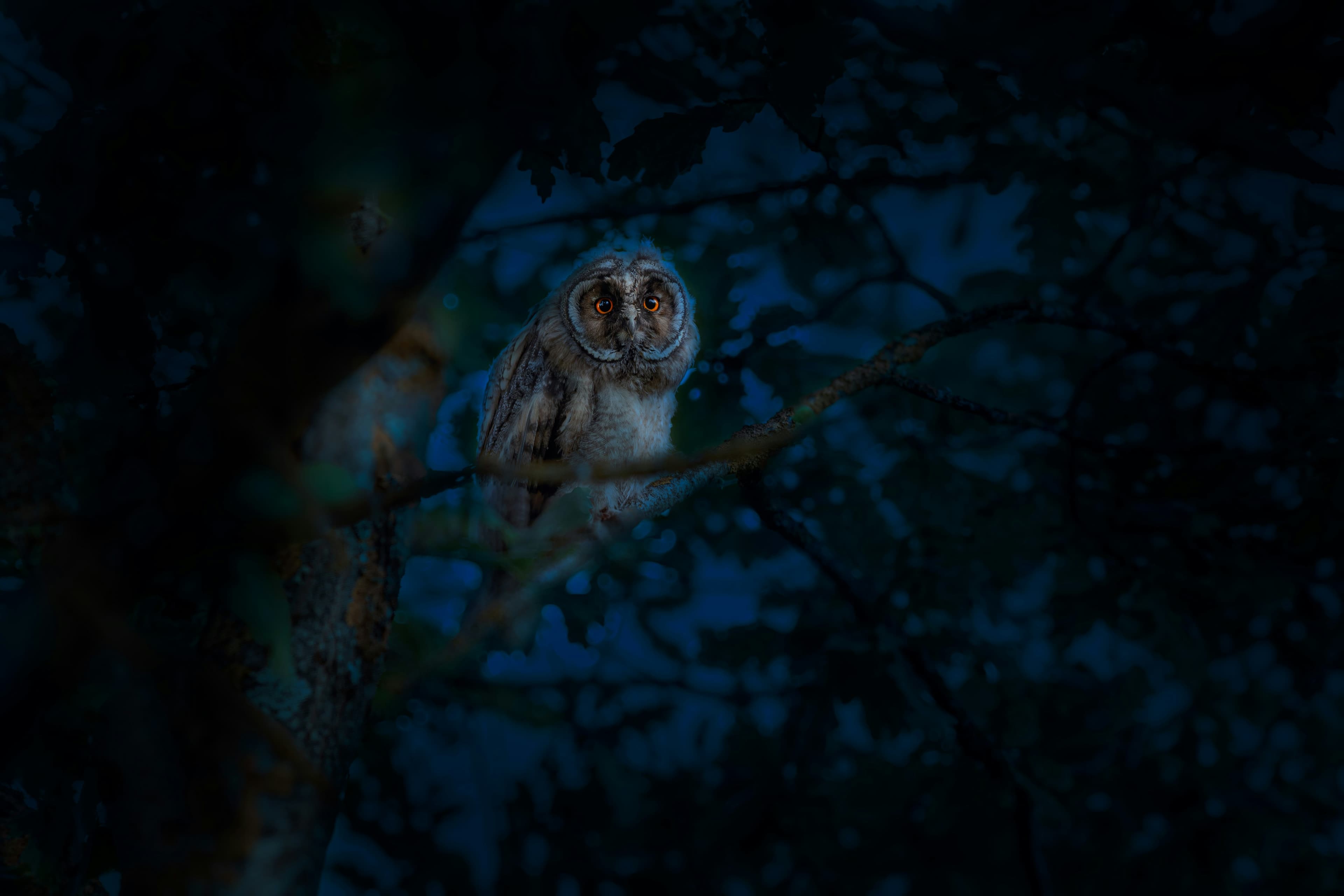
If your weird sound specifically happened after dark, that is its own investigation, with its own suspect list (owls, rails, herons, and a few birds that simply refuse to sleep). We wrote the whole night shift up separately: Weird Bird Sounds at Night is the one you want. Start there and come back.
Reading about a sound is one thing. Learning it by ear is another. W&W turns every bird on this list into a short lesson you actually remember. Download Wings & Whistles Google Play
This is the flavor of weird that makes people check their phone, their car, and their smoke detector before they check the trees.
The sound: An unbroken ramble of whistles, clicks, rattles, warbles, and rude little wheezes, delivered with the confidence of a bird that has never once been asked to stop. It sounds like a modem connecting, or a robot doing improv. Then, without warning, it will produce a perfect car alarm, a perfect Killdeer, or a perfect ringtone, because starlings are mimics and they are not picky.

The tell: Length and chaos. Most birds sing in phrases and take a breath. A starling produces a continuous, seamless stream of unrelated noises. If the sound has been going for twenty seconds and has never repeated itself, and there is a glossy speckled bird on a wire or a rooftop above you, you have found your machine. (Yes, they are the reason so many people are convinced a bird stole a car alarm. They did. See: What bird sounds like a car alarm?)
The sound: A short, strained, ascending screech: the exact noise of an old iron gate being forced open, or a chair leg dragged across a tile floor. Grackles do this while puffing up and tilting their bills to the sky, so you can actually watch the bird visibly straining to produce a sound that is, objectively, terrible.

The tell: It is brief and it is unmusical: one rusty squeak, a pause, another rusty squeak. And it usually comes in numbers, since grackles travel in gangs. A whole flock doing this in one tree sounds like a hardware store falling down a staircase. If you have been quietly blaming a door hinge, we have a post for that too: What bird sounds like a squeaky door?
The sound: A high, squeaky, two-note squee-dee, squee-dee that is the acoustic dead ringer for a rubber duck being squeezed by a toddler with an agenda. Repeated. Enthusiastically. From the top of a pine, by a bird that weighs less than two quarters.

Where: Southeastern pine forests: Georgia, the Carolinas, Florida, anywhere longleaf or loblolly grows. They work the treetops in noisy little squads, which means the squeaking usually comes in stereo. It is the friendliest sound on this list, and the one most likely to make a stranger laugh out loud when you tell them what it is. (More squeak-adjacent suspects here: What bird sounds like a squeaky toy?)
Here is the payoff we promised: two birds whose most famous sounds are not calls at all. They are made with feathers, by moving air, which puts them in a strange category: noises a bird makes with its body instead of its voice.
They also both say peent, which has been confusing people for about as long as people have been writing bird sounds down. Settle that first. It is the single most useful distinction in the post.
Woodcock peent: buzzy, nasal, and coming from the ground. Think a bored kazoo, or a very small duck complaining. It is delivered by a plump bird standing in a damp field, and it repeats on a slow, patient beat.
Nighthawk peent: sharper, thinner, more electric, and it comes from overhead, from a long-winged bird cutting across open sky. If the peent is above you, it is a nighthawk. If the peent is below you, it is a woodcock. That is genuinely the whole rule.
The sound: First the ground-level peent (see above: kazoo, damp field, unbothered). Then the bird launches, and its outer wing feathers start to sing: a high, twittering, chittering whistle that spirals up and up as the woodcock climbs, then chirps and flutters as it drops back down like a falling leaf with opinions. None of that whistling comes from its throat. It is air through feathers, the whole way up.

The catch on timing: the full sky-dance is a spring spectacle, roughly March through May, in the short window of half-light at the edge of the day. It is not a "go outside tonight" bird for most of the year. It is a bird you put on the calendar for next spring, drive to a damp brushy field for, and stand very still in the cold for, and then tell everyone you know about afterward. It is worth it. We made the case at length in Why Do Woodcocks Dance?
The sound: That sharp electric peent from above, scattered across the open sky. And then, if you are lucky, the thing that makes people flinch: a deep, hollow WHOOM, like a distant firework or a race car passing very fast very far away. It is startling out of all proportion to the bird producing it.

Why it sounds like that: The male dives (hard, steep, committed), and at the bottom of the dive he flexes his wings and air rips across his stiffened primary feathers. The boom is the feathers. It is a musical instrument played by falling out of the sky, which is, we would argue, the single weirdest thing on this list, and it happens over parking lots and flat-roofed buildings in ordinary cities all summer long, roughly June through August. (Look up over a lit ballfield. That is the move.)
A fair warning: nighthawks and woodcocks are also part of a bigger evening cast, the birds that get louder as the light drains out of the day. If you want the full lineup of who sings when the sun goes down, that is a different list: Birds Singing at Dusk.
The sound: A long, unspooling, wildly improvised ramble of squeaks, gurgles, whistles, buzzes, and half-finished impressions of other birds, strung together with no discernible plan and no repeats. It sounds like someone slowly emptying a junk drawer of sound effects. The catbird will sing this for ten minutes from inside a tangle of shrubs, and it will never once do the same thing twice.

The tell: Mockingbirds repeat each phrase three or four times, like they are workshopping it. Catbirds do not repeat. Each squeaky idea gets said once and abandoned. That single rule separates the two mimics faster than anything else. (And yes: the bird is named for a completely different noise, a whiny, nasal mew that sounds unnervingly like a cat that wants something. You will hear it eventually, usually right when you have stopped thinking about cats.)
The sound: A breathy, reedy, downward-spiraling flute (vee-ur, veer, veer, veer) that seems to fall away from you as it goes, like water going down a drain if the drain were a woodwind. It does not sound like a bird in a tree. It sounds like a bird at the bottom of a well, or inside your head, and people regularly describe it as the most beautiful weird sound they have ever heard.

Why it sounds impossible: A bird's voice box (the syrinx) sits where the windpipe splits in two, and it has two independently controlled sides. A Veery uses both at once, singing two different notes simultaneously and harmonizing with itself in real time. The ethereal, echoing, slightly ghostly quality you are hearing is not reverb from the forest. It is one small brown thrush running an internal duet, and it does not know it is showing off.
Where and when: Damp deciduous woods with thick understory, late spring into summer, mostly across the northern half of the country. Veeries are drab, shy, and stay low. You will hear the spiral, hunt for the source, and find nothing. That is the ventriloquist tax, and it is non-negotiable.
You do not need to memorize 11 recordings. You need a filter. When something strange arrives, run it through three questions in this order and you will land in the right neighborhood almost every time:
Then do the part that actually makes it stick: listen to the clip on purpose, one bird at a time. Play the bittern three times today. Tomorrow, play it once and see if the marsh comes back to you before the sound does. That is the whole method: small, repeated, unhurried. We laid out a two-week version of it in How to Learn Bird Songs by Ear, and a broader ID walkthrough in How to Identify Bird Sounds.
Descriptions get you close. Hearing the clips back to back, then being asked to name them cold, is what closes the case, and that is what Wings & Whistles is for. Weird sounds are ideal beginner material, honestly. Nobody forgets the bird that sounds like a sump pump.
Ask ten birders and you will get ten answers, but the honest winner may not be a voice at all. The Common Nighthawk's booming dive and the American Woodcock's twittering climb are both made by air rushing over stiffened feathers: a bird playing itself like an instrument. If you insist on a vocalization, the American Bittern takes it. A bird that inflates its esophagus to imitate failing plumbing has earned the title.
That is the American Bittern, a heron-shaped marsh bird whose onk-a-CHUNK pump-call carries through dense cattails. Nicknames like "thunder-pumper" and "stake-driver" are centuries old, which should tell you how long people have been mistaking it for machinery. If the foghorn is coming from open sky rather than reeds, you are hearing a Sandhill Crane instead.
The Common Loon. The wavering laugh is the tremolo, an agitation call. The long, mournful howl is the wail, the far-carrying one loons use to locate each other across a lake. Laugh means annoyed. Howl means looking for someone. If a loon tremolos at your canoe, take the hint and paddle wide.
Because the noise is doing a job. Low booming carries through dense marsh vegetation where a pretty whistle would die in the reeds. Sharp electronic tones cut through cluttered forest. Mimics like starlings and catbirds appear to build bigger repertoires because bigger repertoires impress mates. Nothing here evolved to sound strange. It evolved to be heard. The strangeness is our contribution.
The usual overnight suspects are the Eastern Screech-Owl (a hollow purring trill or a descending horse-like whinny; despite the name, it rarely screeches), the Common Loon if you are near a northern lake, and a surprising number of birds that simply do not stop singing after dark. Our full night guide is Weird Bird Sounds at Night.
Do not memorize recordings. Learn categories, then one bird at a time. Sort a strange sound into pumps, ghosts, machines, or ventriloquists, note where it came from and whether it repeats, then play the clip for your best guess on purpose, a few times, across a few days. Wings & Whistles builds each species into a short guided lesson so the sound gets tested back to you instead of just played at you, which is the difference between hearing a bird and knowing one.
Sources
Here is what actually changes once you learn these. The marsh stops being an ambiguous, faintly menacing wall of reeds and becomes a place where you know a bittern is standing, doing its ridiculous impression of a broken pump. The dark backyard stops being a dark backyard and becomes an address where a very small owl lives. The sound that made you check your smoke detector turns out to be a starling on a wire, workshopping a car alarm it heard last Tuesday.
None of it gets less strange. It just gets less anonymous. And honestly, a bird that harmonizes with itself is a much better story than a ghost.
Open any bird for its recordings, what to listen for, and the birds it gets mistaken for.
Start learning birds by ear, one weird sound at a time. Download Wings & Whistles Google Play
The 2 AM edition. Match the strange call you heard to the most likely species using sound clues, habitat, and time of year.
Droids, laser guns, and horror-movie wails: 7 birds that sound like they escaped from a sound-effects library.