What Bird Sounds Like a Machine Gun (or Knocking on Your House)? Learn the Drummers by Ear
Nov 14, 2026 8 min read
It is six in the morning, barely light, and something on the side of the house opens fire. A short, hard burst, rat-a-tat-tat-tat-tat, so fast the hits blur together, ringing off metal. Silence. You are halfway back to sleep when it fires again, from the same spot, at the same speed. Then again. Somewhere around the fourth burst you start to wonder whether the gutter is under attack, and by the tenth you are typing "bird that sounds like a machine gun" with one eye open.
Short bursts of fire at six in the morning
Good news first: nothing is shooting at you, and nothing is necessarily eating your house. A burst that short, that even, and that loud, repeated from one spot with pauses in between, is a woodpecker drumming. It is not looking for breakfast. It is announcing itself to the neighborhood, and your gutter is the loudest instrument on the block.
What bird makes a machine-gun or knocking sound?
Rapid bursts of knocking that sound like a machine gun are almost always a woodpecker drumming, which is a territorial signal, not feeding. Short, even rolls are usually a Downy Woodpecker. Near water, a loud, dry rattle from a bird in flight is a Belted Kingfisher. The viral 'machine gun bird' videos show an African Shoebill clattering its bill.
Downy Woodpecker: Drumming
--:--
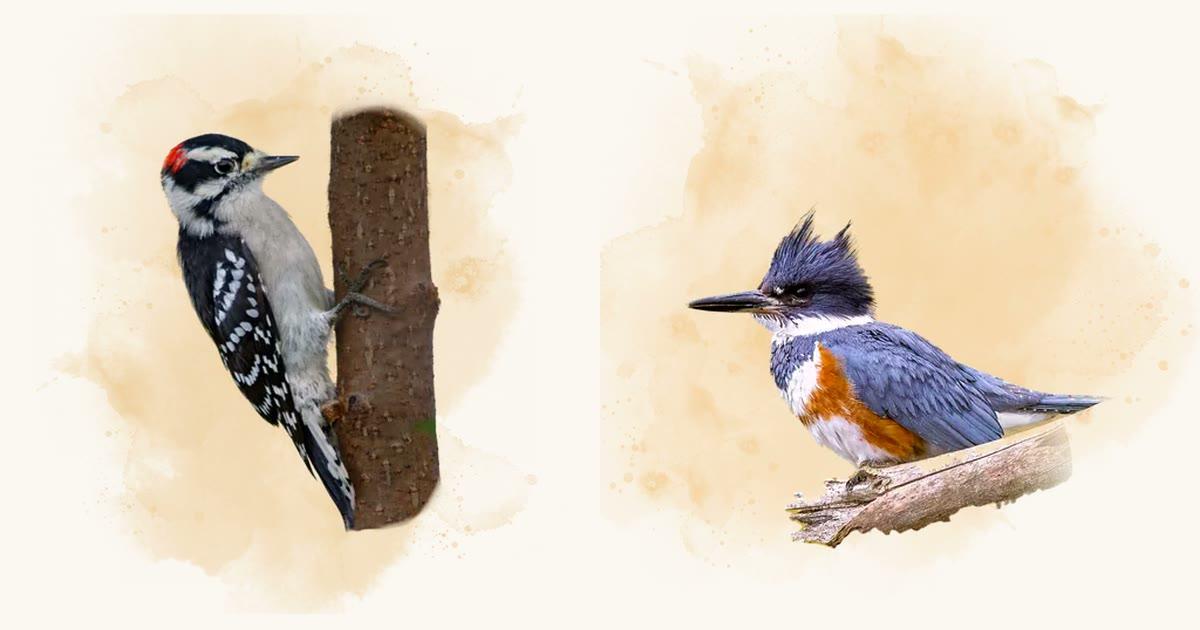
That is a Downy Woodpecker drumming on a resonant branch: five rolls, each one over in under a second, with a few seconds of silence between them. Tap along and you will notice the rhythm never changes inside a roll. Steady, fast, done. Hold on to that, because it is the yardstick for everything else on this page. (The Downy is the small black-and-white woodpecker on your suet feeder, about the size of a sparrow with better posture.)
Something drumming on the house right now? Record ten seconds in Wings & Whistles. Get the app free →
Quick Suspects
Short, even, fast rolls of about a second, from a branch or a gutter:Downy Woodpecker.
The same even roll, but louder and faster, so tight it nearly blurs into one sound: a Hairy Woodpecker.
A quick burst that breaks into a few slow, uneven taps, like Morse code:Yellow-bellied Sapsucker.
A slow, deep, loud roll of two or three seconds that fades away, from big woods:Pileated Woodpecker.
Deafening drumming on a chimney cap, metal flashing, or a utility pole in spring, with a loud wick-wick-wick shouted between bursts: often a Northern Flicker.
A rolling, churring kwirr between bouts of drumming, in eastern woods and yards: a Red-bellied Woodpecker, which calls and drums.
A dry, clattering rattle from a bird flying along a creek or shoreline:Belted Kingfisher.
A low thump, thump, thump that speeds up into a whir, from the forest floor in spring: a Ruffed Grouse beating its wings in the air. It is not hitting anything at all.
Tapping on a window, in fits, for days on end: a Northern Cardinal or American Robin fighting its reflection.
Woodpeckers do not sing, at least not the way a robin does. They drum instead: a burst of rapid strikes on something hard, used for the same jobs a song does, which is claiming a territory and telling a mate (or a hopeful one) where to find them. It is one of a handful of bird sounds made without a voice at all, and our tour of weird bird sounds has a few more.
Because the message is the sound and not the hole, the instrument matters more than the wood. A woodpecker shopping for a drum wants the loudest, most resonant surface it can find. In a forest, that is a dead, hollow limb. In a neighborhood, it can be a gutter, a downspout, the metal flashing around a chimney, a vent cap, or a satellite dish. Metal also explains why so many people search for a bird that sounds like a jackhammer: the same roll that sounds woody on a branch comes off a gutter sharp, ringing, and mechanical.
So a drumming woodpecker is not boring into your siding or finding bugs in your gutter (there are none worth the trouble). It is broadcasting, which is why it comes back to the same spot tomorrow, and the day after: a good drum is worth keeping.
Three different sounds get lumped together as "a woodpecker pecking," but once you know what each is for, they are easy to pull apart. Drumming is loud, fast, and rhythmic: bursts of roughly the same length, from the same spot, with pauses between. It is a performance, so it is built to be heard. Feeding is quieter and messier: a few taps and picks, a pause, a few more, with the bird hitching around the trunk as it goes. There is no beat because the bird is working, not performing. Excavating a nest or roost hole is slower and heavier, a steady chiseling with wood chips raining down below. If you find chips on the ground or a round hole in your trim, you have a carpenter, not a drummer, and that is a different conversation.
Timing helps too. Drumming picks up in late winter and runs through spring, when territories and pairs are being settled, and it is most intense in the morning. Some woodpeckers drum again in fall, more briefly, though it is never as steady as the spring season. And if the drummer on your chimney cap is big, brown, spotted, and wearing a black bib, it is probably a Northern Flicker, one of the usual suspects when the drumming is on metal or the house itself, and loud about it.
Read the rhythm: even, stuttering, or slow
Knowing it is a drum roll gets you to "a woodpecker." The rhythm gets you to a name. You do not need to see the bird. You need a table and one finger. Every drum roll has three things you can hear: how fast it is, how even it is, and how long it lasts. Change one of those and you are listening to a different bird. Picture a ladder with three rungs, and climb it one change at a time.
Rung one: even and fast. This is the Downy at the top of the page. Every strike evenly spaced, the whole roll over in about a second, then silence. Tap as fast as you comfortably can for a count of "one-Mississippi" and stop dead. That is a Downy. Its bigger lookalike, the Hairy Woodpecker, plays the same even roll, only faster and louder, so tight it almost buzzes. If the Downy is a snare drum, the Hairy is the same drummer after three coffees. Telling those two apart takes practice, but here is a head start: a Downy fires again every few seconds, while a Hairy makes you wait, often twenty seconds or more, between bursts.
Rung two: keep the speed, lose the evenness. Start with that same fast burst, then let it fall apart. The Yellow-bellied Sapsucker opens with a quick roll and then breaks into a ragged string of uneven taps and double-taps, as if the drummer lost the beat and is feeling around for it: brrrrrt, tap-tap, tap... tap-tap... tap. Birders describe it as Morse code, and once you hear it, it may be the easiest drum roll in North America to name.
Yellow-bellied Sapsucker
--:--
Sapsuckers are notorious for picking metal road signs as drums, so a Morse code message hammered out on a sign by a back road is worth a second look. The other giveaway is on the trees. Sapsuckers drill neat horizontal rows of small holes in birch, maple, and other trunks, then come back to lick up the sap that collects there. If the trees near the drumming look like someone punched them with a hole punch, you have your bird. You are most likely to hear the Morse code in spring in the northern states, Canada, and the Appalachians, where sapsuckers nest. Farther south they are mostly winter visitors. The Yellow-bellied Sapsucker species page has more on where to find one.
Rung three: slow it down and let it fade. Go back to one long, unbroken roll, but ease off the speed a little, drop the pitch, and stretch it out. A deep, loud roll that runs a good two seconds or more, never quite holding a steady tempo, and goes soft as it trails away at the end is the Pileated Woodpecker, the crow-sized one with the flaming red crest.
Pileated Woodpecker
--:--
Compared with the Downy, this hardly sounds like a machine gun at all. It sounds like someone knocking on a hollow door with a mallet, somewhere far off in the woods, and that is the point: a big bird on a big dead trunk carries a long way. Pileateds live year-round in mature forest across the East, through Canada, and down the Pacific Northwest, and more and more of them are learning to live with us, in older suburbs and city-edge parks with big trees (more on the Pileated Woodpecker species page). They also have a voice to match the drum, a wild, ringing call that sends people looking for a bird that sounds like a monkey. That one is a different lesson.
So: even and fast, stuttering into Morse code, or slow and fading. Most backyard drumming in the East lands on the first rung, and if yours did not, the rhythm tells you which way to climb. One warning before you leave the ladder. If your machine gun never stopped, a steady, unbroken buzz or trill running for many seconds from the grass or the trees on a warm night, it is probably not a bird at all. Our guide to telling insect sounds from bird songs will sort that out.
Even, stuttering, slow. Three drum rolls, three woodpeckers. Learn them by ear and the 6 a.m. gutter concert gets a lot more interesting. Download Wings & Whistles Google Play
A machine gun over the creek is not a woodpecker
Everything on the ladder has one thing in common: it stays put. A drummer picks a drum and keeps hitting it. So if your machine gun moved, sweeping along a creek, passing over a pond, fading off downstream, the ladder does not apply. You did not hear a drum. You heard a voice.
That voice belongs to the Belted Kingfisher, and its call is a loud, dry, mechanical rattle, like a stick dragged fast along a picket fence or a fishing reel letting out line. This clip was recorded as a kingfisher flew in and out of its nest, so the rattles you hear are given in flight, which is how most people meet them.
Belted Kingfisher
--:--
Listen to how dry it is: no ring, no woody knock, none of the resonance of a drum on a dead limb. It is all voice, and it carries. Kingfishers rattle as they fly their beat along the water and when something gets too close, so you usually hear one before you see it: a big-headed, blue-gray bird with a shaggy crest and a dagger of a bill, flying low and straight over the surface. Here is the detail to tell a friend: kingfishers are one of the few North American birds where the female is more colorful than the male, with an extra rusty band across her belly.
Look for them along streams, rivers, ponds, lakes, gravel pits, and coasts, anywhere with small fish and a dirt bank to dig a nest burrow in. They stay year-round wherever the water stays open and pull back south from places where it freezes. This is also the answer for anyone who searched "bird that sounds like a rattle": near water, it is almost always the kingfisher. The Belted Kingfisher species page has the rest of its story.
People also search for a bird that sounds like a rattlesnake. That is the Burrowing Owl, whose young, cornered in their burrow, give a buzzy hiss that sounds remarkably like a rattlesnake (a decent bluff for a bird that lives underground in western grasslands and Florida). We do not have a clip of the hiss yet.
Knocking on the window is a different bird
Some knocking is not drumming at all, and the surface gives it away. If the tapping is on glass, a window, a sliding door, a car mirror, and it comes in fits all day, day after day, the bird is not making a statement. It is in a fight. It sees its own reflection, takes it for a rival on its territory, and attacks. The rival, unhelpfully, attacks back.
Run it through the drumming test and it fails every point: no steady rhythm, no matching bursts, and usually no woodpecker. The usual culprits are the Northern Cardinal (the same bird whistling birdy-birdy-birdy from the treetop) and the American Robin, though bluebirds, mockingbirds, and plenty of others do it too. It is a breeding-season habit, strongest in spring and early summer, and it usually fades once nesting winds down.
The practical fix is to break up the reflection from the outside of the glass, with closely spaced decals, tape strips, soap, or a screen, so the window stops showing the bird a rival. Beyond that, it is a behavior question rather than a sound question, and it deserves its own guide.
Learn three drum rolls this winter
Drumming is the woodpecker's spring song, and spring starts early for woodpeckers. Downies and Pileateds tune up in late winter, on still, cold mornings when the trees are bare and sound carries. Learn the rolls now, while the woods are quiet, and February pays you back.
The drill takes two minutes. Play the Downy, the sapsucker, and the Pileated on this page back to back, and tap each rhythm on the table while it plays. Do it twice. Then have someone else press play in a random order, and tap first, name second: "even," "Morse code," or "slow fade." Naming the shape before the bird is the real skill, and it is how experienced listeners sort sounds long before they know every species. For the method behind it, start with how to learn bird songs by ear. For a few voices to practice on cold mornings in the meantime, try our winter bird sounds guide.
Once those three come easily, the rest of the family is next. In the Wings & Whistles app, Woodpecker Workshop puts the Downy, Hairy, Red-bellied, flicker, and Pileated in one lesson, so the family stops blurring together. Woodpeckers Beyond the Drum adds the sapsucker. And the kingfisher lives in Waterline Radio, alongside the loon, the heron, and the bittern, the other voices you hear from the water's edge.
FAQ: Birds that sound like a machine gun
What bird sounds like a machine gun?
Usually a woodpecker drumming. Short, even, rapid bursts repeated from one spot are a territorial signal, and the bird picks the loudest surface it can find, including gutters and metal flashing. Near water, a loud, dry rattle from a bird in flight is a Belted Kingfisher. The viral machine gun bird videos show an African Shoebill clattering its bill.
Why is a woodpecker pecking on my house or gutter?
Most of the time it is drumming, not feeding. Woodpeckers drum to claim a territory and attract a mate, and metal gutters, downspouts, and chimney caps make a louder drum than any tree. Drumming peaks in late winter and spring, often in the morning. If you find holes or wood chips, the bird may be feeding or excavating instead.
How can you tell woodpecker drumming from a woodpecker looking for food?
Listen for a beat. Drumming has one: loud bursts of about the same length, repeated from the same spot. Feeding does not. It is quieter, a few irregular taps and picks while the bird moves around the trunk. Slow, heavy chiseling with wood chips falling below means the bird is excavating a hole.
What bird makes a loud rattling sound near water?
A Belted Kingfisher. Its call is a loud, dry, mechanical rattle, often given in flight as the bird travels along a stream, pond, lake, or shoreline. Unlike a woodpecker drumming from one spot, the rattle moves with the bird. Kingfishers stay year-round wherever the water stays open and move south from places where it freezes.
What bird sounds like a rattlesnake?
The Burrowing Owl. When young owls are cornered in their burrow, they give a buzzy hiss that sounds remarkably like a rattlesnake, a useful bluff for a bird that lives underground. Burrowing Owls live in open grasslands and deserts of the West and in parts of Florida.
Why is a bird knocking on my window every morning?
It is almost certainly fighting its own reflection. During the breeding season, territorial birds such as Northern Cardinals and American Robins see their reflection as a rival and attack it, sometimes for days or weeks. It is not drumming, and it is rarely a woodpecker. Breaking up the reflection on the outside of the glass usually ends it.
Birds in this guide
Open any bird for its recordings, what to listen for, and the birds it gets mistaken for.
Learn the three drum rolls on this page before drumming season starts in late winter, then meet the whole family in Woodpecker Workshop. Download Wings & Whistles Google Play